Wednesday, June 26, 2013

Book Review: The City & The City by China Mieville

The City & The City is a detective novel by China Mieville. I'm a fan of Mieville for his intricate language, the worlds he creates, and the unique place that Setting has in his stories. I had already read this book several years ago when it won the 2012 Hugo award for best novel (tied to Paolo Bacigalupi's The Windup Girl). However, I recently recommended it to the book club I'm in and was happy to see it accepted as this month's pick. Interestingly enough, there is a set of discussion questions at the end of the book for any reading groups. I've only seen that in a few books, but it's a great way to encourage deeper discussions.

So what's the book about? It's a police procedural, anti-fantasy story where a dead body is found in one city, but the murder appears to have taken in another city. However, while these two cities are in exactly the same place, they are in completely separate countries and people from one cannot see, hear, or interact with those of the other. As the investigation proceeds, we learn both rumors and facts about that which lurks in the gaps between the city and the city.

Read on for my (spoiler-free) review.

Tuesday, June 25, 2013

Astronomy: New Potentially Habitable Planets

Artistic depiction of the view from Gliese 667Cd. Credit: ESO/M. Kornmesser

The recent news is that 2 more planets in the Habitable Zone of the star Gliese 667 (aka GJ667) have just been discovered. These are GJ667C f and e. I had previously written about GJ667Cc, another habitable world in the same system. It appears that this star system could host 3 planets that, if the conditions are right, could harbor liquid water on the surface of the planet.

These planets join a growing list of potentially habitable planets.
List of potentially habitable planets. Credit: PHL @ UPR Arecibo

The figure above shows a dozen planets thought to be most likely to be habitable. Note that a few, like Gliese 581g, are unconfirmed.

The planets are ranked by the "Earth Similarity Index" or ESI, which I recently learned is an index that measures how similar a planet is to the Earth. It compares the radius, density, surface temperature, and escape velocity to that of Earth's and values close to 1 are very good (ie, Earth-like). I was surprised to see escape velocity among the parameters (since it depends on the mass and radius) given that the density, which also folds in the mass and radius, is already considered.
Note that despite the high temperature on the surface of Venus, the mass and radius are so similar to the Earth that the ESI is close to 0.8. However, Venus is not in the habitable zone as it's too close to the Sun.

This is an exciting time for planetary research in astronomy as more and more planets are being discovered and we are starting to probe planets whose conditions may be favorable for liquid water and ultimately, we hope, for life.
Friday, June 14, 2013

Astronomy: A Video of the Local Universe

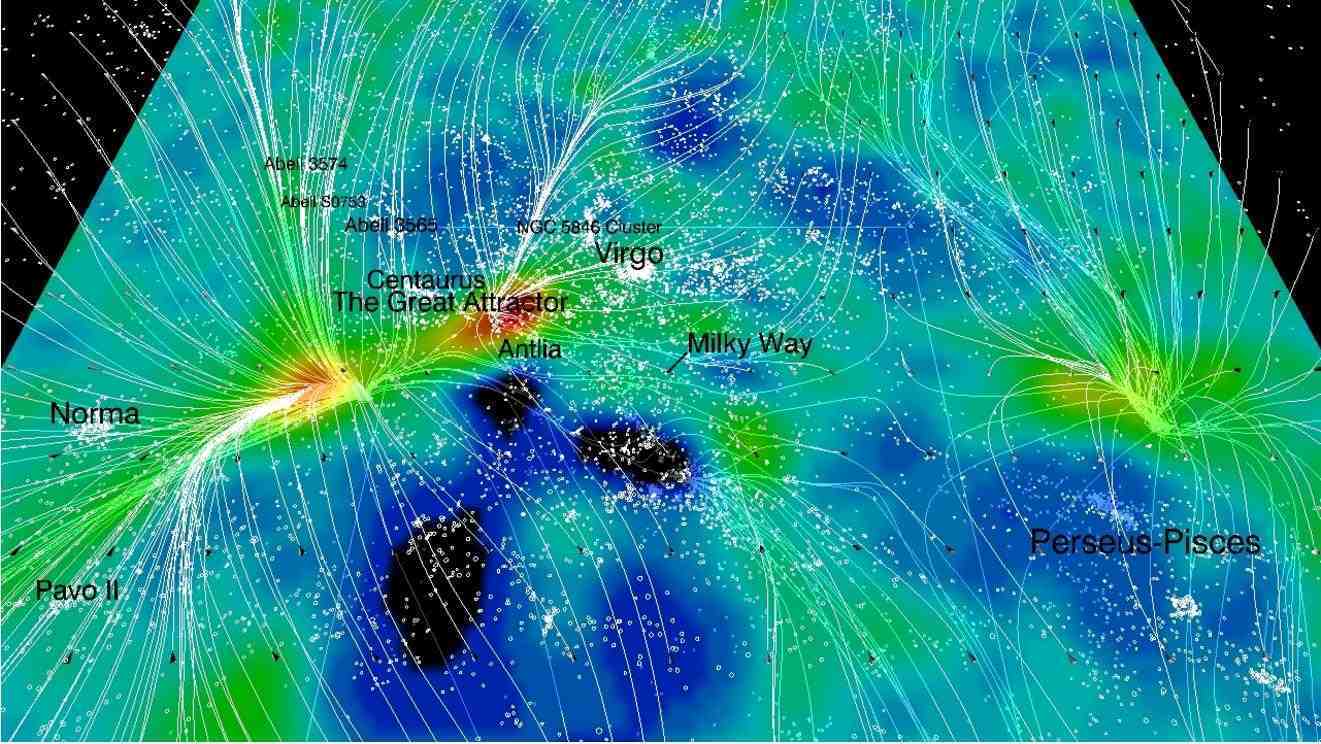
Cosmic flow near the Local Group of galaxies. Credit: Courtois et al 2013; Cosmic Flows conference.

You don't need to be an extragalactic astronomer to find the video below amazing.
This 17-minute video walks you through the distribution and velocities of galaxies within 300 million light-years of the Milky Way Galaxy. Distinct regions like the Virgo Cluster, the Local Void, and the Great Wall are easily seen and pointed out by the video. There's a lot of rotations going on, and the field of galaxies is complex, but the video does a good job of highlighting what's important at each step so that one is not completely overwhelmed. It's great to see where all these structures are and be reminded of how large the Universe is, as I tend to deal with stars that are a million times closer.

Check it out:

Thursday, May 30, 2013

Book Review: The Rithmatist by Brandon Sanderson

The Rithmatist is a young adult novel written by Brandon Sanderson. I feel it hasn't been advertised as much as some of his other books and novellas. Even now you hear more about Steelheart, his next novel, than about The Rithmatist. And that's a shame, given how fun The Rithmatist is.

This is a story set in an alternate Earth where certain people, Rithmatists, can use geometry-based magic. By drawing lines of chalk, they are able to produce physical effects that help them in the never-ending battle against wild chalklings. These wild chalklings are controlled by no man, yet flow forth from a mysterious tower. In the midst of all this, students at a prodigious school start disappearing, seemingly kidnapped by a rouge Rithmatist. Joel, a young boy without Rithmatic abilities, but all the desire in the world to be one, quickly gets involved in the investigative work to figure out who is behind these kidnappings.

Read on for my full review.

Saturday, May 25, 2013

Book Review: Gone Girl by Gillian Flynn

This is quite different from the sorts of books I read. It's not even remotely science fiction or fantasy. I've read it as part of a book club I'm joining here in Chile. It's a suspense novel about a marriage of a sociopath and a narcissist and it has gone horribly wrong. It may not be what I'm used to, but I actually enjoyed it!

Here's my review.

Saturday, May 18, 2013

Book Review: Reaper's Gale by Steven Erikson

Reaper's Gale is the 7th in Steven Erikson's Malazan Book of the Fallen series.

For long series like this one, it's sometimes difficult to split the thoughts into each individual book. However, now that I think about it I realize that the Malazan series tends to have a unique and separate focus for each book, which greatly helps to keep them apart:
In Book 1, we see the fall of Darujhistan as part of the Malazan conquest of Genabackis. In Book 2, we see the Seven Cities rise up in the Whirlwind Rebellion. In Book 3, the Malazan empire gives answer to the threat from the Pannion Domin in Genabackis. Book 4 introduces us to the very interesting Karsa Orlong and his role in the Whirlwind and the House of Chains. Book 5 places us among the Tiste Edur and we see the Emperor of a Thousand Deaths emerge. In Book 6, the Malazans confront the remnants of the Army of the Apocalypse in Seven Cities and set off to answer the growing threat of the Tiste Edur. And all throughout these books we see the influence of the Crippled God and the rise to power of his House of Chains.

My review of book 7, Reaper's Gale, now follows.

Monday, May 6, 2013

Smog in Santiago

Santiago, Chile: April 30, 2013

Santiago has some of the worst air pollution of any city I've been to. Last week, I took a few pictures from my office that very vividly illustrate the problem here. The first is above, for the next few and some discussion, keep reading.

Friday, April 19, 2013

Astronomy: More and More Planets

Artist depiction of Kepler 62f

In the latest astronomy-related news, a pair of planets in the habitable zone of a distant star has been found by NASA's Kepler spacecraft. Tons of newspapers and websites are reporting on Kepler 62. We already have several promising planets in the habitable zones of other stars, but it's a good thing to excite the public's interest in such topics. In our current times of budget cuts, it's important to emphasize the role science and astronomy have in our lives and our culture.

In addition to the reports on the planetary system, the New York Times released an impressive visualization/infographic of many of the Kepler planets discovered to date. It's very much like the older Kepler orrery, but this one is interactive so you can see extra information on the system like the name, any artist conception, or any article associated with it. Go check it out!

The New York Times Kepler planet infographic