Showing posts with label Culture. Show all posts

Saturday, April 28, 2012

Transit of Venus: June 2012

On June 5/6, 2012 we will witness one of the rarest, yet predictable, astronomical phenomena: the transit of Venus.

What is a transit?
Just like the Moon will sometimes pass between the Earth and the Sun (causing a solar eclipse), so too do the planets on inferior orbits. In other words, Mercury and Venus, which orbit closer than the Earth, will sometimes appear to cross the disk of the Sun. Since the planets are farther away than the Moon and orbits are not perfectly aligned, these events are much rarer than solar eclipses.

Transits are rare since the orbit planes and planet positions do not always line up.

Venus transited the Sun back in June of 2004, here's what that looked like:
The June 2004 transit of Venus

The cycle continues 8 years later on June 2012. After that, though, you'd have to wait 105.5 years for the next transit: on December 2117, and then again 8 years later on December 2125. After that it's 121.5 years until the next one and then the cycle repeats (121.5, 8, 105.5, 8). Add up the numbers and you'll see this is a 243-year cycle. It is unlikely that anyone reading this blog today in 2012 will be alive on 2117 given the current human lifespan, so you do NOT want to miss this event.

Note that as the planet crosses the Sun it blocks out a tiny portion of the stellar disk. We're close enough to the Sun (93 million miles) that we can see the transit easily. It turns out that we can apply this same technique, though, to far more distant stars. For distant stars we can't see the disk of the star or the planet (it all just looks like a tiny point of light), but we can see how the brightness of the star changes with time. If the planet is big enough, when it crosses the star it will make the star appear just a little bit dimmer. With careful monitoring of a star's light, we can spot this change in brightness and, if periodic, infer that a planet is in the system. This can then be used to determine properties like the orbit of the planet and the planet size. This is called the transit method for extrasolar planet searches and is the way in which the Kepler spacecraft has found over a thousand candidates exoplanets.

A planet transits in front of a distant star.

Where can I watch the transit of Venus?
The transit will be visible from the majority of the planet, however the best place to look is in the middle of the Pacific ocean or in East Asia. People in North America can see the start of the event until the Sun sets, people in Europe and the Middle East can see the end of the event after sunrise.
Here in Chile, things don't look to promising but we have a plan (see below).

June 2012 transit visibility

Note that it is dangerous to look directly at the Sun! You want to make sure you have proper gear: eclipse viewing glasses, solar filters for telescopes, or project the image of the Sun to a piece of paper. You can create a simple pinhole camera with a few sheets of paper and a pin (to make the hole). Here is a PDF file with some instructions on how to do that. You can find more information on how to safely observe the Sun here.

One of the best ways to experience the transit, though, is with a locally hosted star party so you can share good equipment. Here is a good website to get additional information on the transit. You can also check out this website to find out the exact times for the transit event at any location on Earth.

Why are transits so important?
Since the invention of the telescope only 6 transits of Venus have been observed. A 7th, the first one predicted using the Laws of Gravitation, took place in 1631, but was not visible from Europe and went unobserved. The 2012 transit will be the second in this new era of rapid global communications (the prior one to 2004 was in 1882). Besides the historical importance of this rare event, there's also useful science that can be carried out, such as studying the atmosphere of Venus or characterizing the transit for extrasolar planet searches. One of the coolest (and simplest) things one can do with the transit, however, is calculate the distance between the Sun and the Earth- the Astronomical Unit (AU, see my post on distance here). The precise timing of the transit in various places on the Earth, combined with some very simple geometry, can be used to estimate this distance. The basic idea is that of parallax, just like for the definition of the parsec. Once you have that down, you get the scale of the solar system and can figure out how far away the different planets are.
UPDATE: I describe the basic math and the required measurements here.

Here is a neat video about the transit, determining the distance to the Sun, and how this all relates to the search for extrasolar planets with facilities like the Kepler Space Telescope:

What about Chile?
Our own team of Chilean astronomers will be hosting a viewing event and outreach activities (including star gazing as there's a partial lunar eclipse on June 4). This will be at Easter Island since the Chilean mainland will not be able to see the transit. I encourage you to join a viewing party, either ours in the exotic Easter Island or one close to your home. You do not want to miss this!
Details for the Easter Island event can be found here (Spanish) or here (English).
Be sure to share this (and our Facebook page) with anyone you know that might be travelling to Easter Island!

Monday, January 23, 2012

Santiago a Mil: El Encanto del Rio Amarillo

Santiago a Mil is an international theater festival that's been going on in Santiago (and a few other cities in Chile) for the month of January. This past weekend was the end of the festival and I had the chance to go see Titanic (see my thoughts here) and El Encanto del Rio Amarillo (The Charm of the Yellow River).

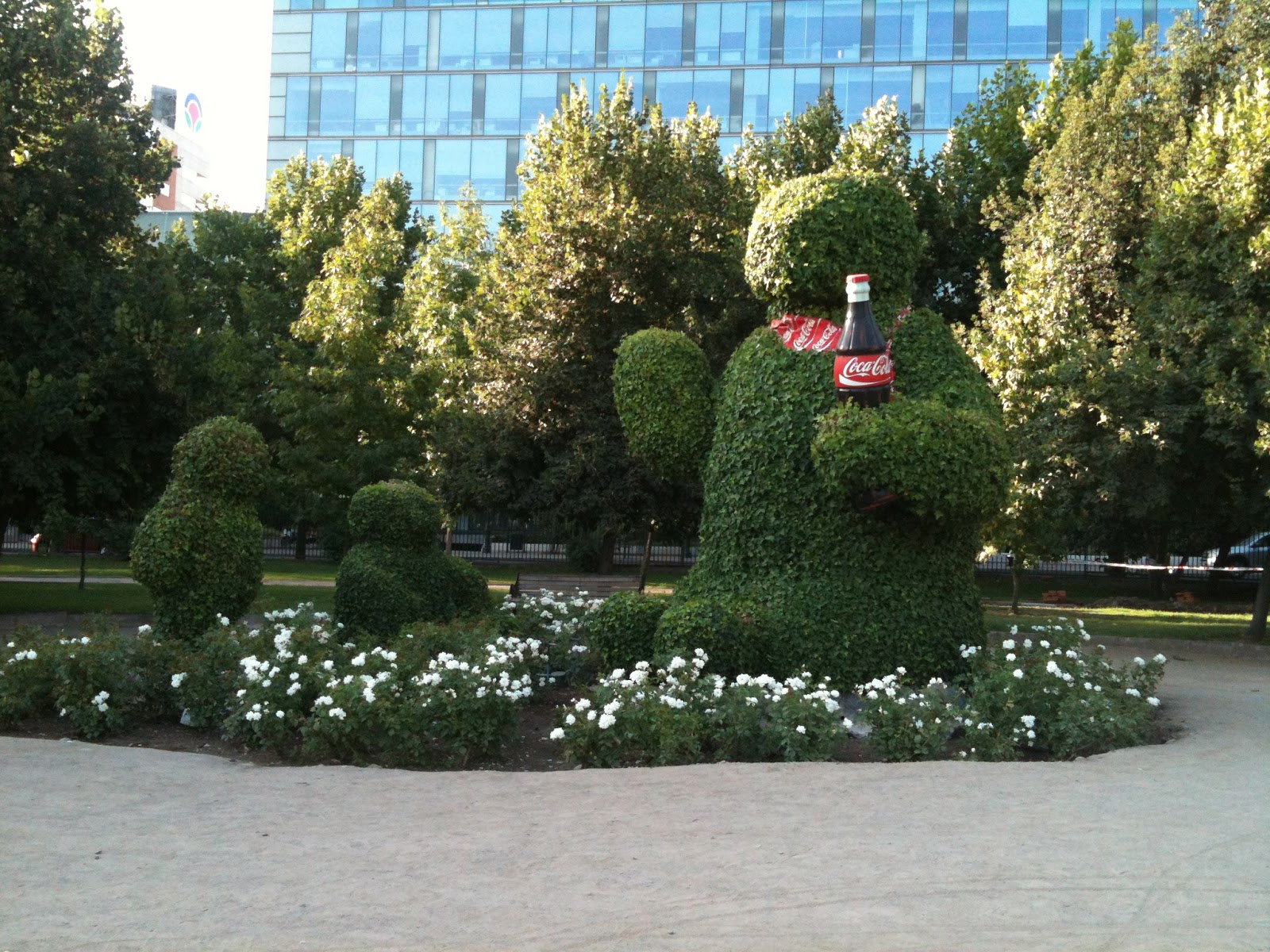
Sunday evening I set out to the Parque Araucano, which is not too far from where I live. This is the first time I went there, but it was not difficult to find and the stage was under a big Santiago a Mil balloon. I'll have to check out the park more carefully in the future. What I saw looked nice, but I hear there's also an aviary and rose garden. Also, I saw a family of bears with Coca-Cola:

But enough about the park. What I went to see was a performance by the Shanxi Song and Dance Troupe. This was a set of 12 dances and songs typical of the Shanxi province in northern China. It's sort of fitting considering the Chinese New Year started on Monday January 23, hence this was like a New Year's Eve.
There were plenty of seats at the park so it was more comfortable than the Titanic showing and the stage was high up so everyone could see. However, the music was a bit loud and slightly painful for the high-pitched instruments. I had a mild headache by the end of the (slightly over) 1-hour show.

We were given a program with the twelve parts, so I'll just go over each part with my opinions and pictures/videos. Remember that you can click the pictures to see them larger and that videos on YouTube also can be seen larger. The videos aren't too long and are only meant as a preview to emphasize what you missed.

First up: Tambor y Danza Oriental (Oriental Drum and Dance).
Nothing really stands out about this one in particular. Many of the dances and music performances were either about the harvest (or farming), about weddings, or just about being happy.

Second, was a solo drum performance by Cao Yan. Here's a video of part of it:
This was quite impressive. Parts were excruciatingly slow, but others were so fast I thought he would break the sticks. This was supposed to be about harvest, but I don't see how.

Next up was Linterna Roja (Red Lantern), which I think of as the main piece of the show:
Lots of happy girls jumping around with their lanterns. Santiago a Mil has an official 5-minute recording you can see here.

The next one, I could have done without. This was Rio Amarillo-Nuestro Rio Materno (Yellow River- Our Maternal River).
The man in blue-green on the left is playing the suona. What the video fails to capture is that this went on for 7 minutes, making it one of the longer pieces. The blaring of the suona for that long gave me a mild headache that did not improve with the following performances. I saw some people covering their ears. The music was really too loud and not helped by the suona.

Disfrute del Yangee (Enjoy the Yangge)
If I hadn't recorded this video I would have no memory of this one. This was one of the few pieces with vocals in the music. 

Next was a two-piece music performance. A solo of the erhu performed by Liu Hongshu.
My video captures the first part: Caballos Galopando en la Llanura (Horses Galloping on the Plain). My only regret is that this isn't really a solo: there's a pre-recorded orchestra in the background. That makes identifying the erhu much more difficult. Still, it was nice and fast paced. At the end, the musician actually make the instrument neigh like a horse. Impressive.


The following was one of the many wedding pieces: Al Compas del Tambor (To the Rythm of the Drum):
The drummers were all joyously jumping around and playing pranks on the bride and groom.


Another wedding, but more unusual: La Boda del Raton (The Rat's Wedding):
This was not a dance, just the 5 musicians performing. It was actually quite nice, a few parts reminded me of the music of the anime Mushi-Shi, which is one of my favorites series. At the end, a cat shows up (ie, one of the musicians 'miaus') and the song ends.


La Camara Nupcial (The Bridal Chambor) was the next piece. No good video, but I have a picture.:
This is what goes on when the bride and groom meet to consumate their (pre-arranged) marriage. The guy was all excited and quickly got into the proper attire. The girl was a bit shyer and it didn't help that she was wearing 3 or 4 shirts. Here she is trying to hold on to the first shirt. It was actually a pretty funny piece.

We follow that with one of the harvest-related dances. Cantaros de Comida (Food Jars)
This depicts the women bringing food to the men working out in the fields. However, with all the dancing around they do the food would have gotten cold by the time they reach them...


Next up is (yet another) wedding piece: Cancion de Boda (Wedding Song). No video, just a picture:
What's that in the table? Why yes, it happens to be some Chilean wine. It is declared good and the music continues. It's a bit ridiculous in that the two main musicians use funny sounding instruments and then their own voices to make very high-pitched, cartoonish noises as they argue.

And the last piece of the night harkens back to the Yellow River with Tambor del Rio Amarillo (Drum of the Yellow River).
One of the best parts, which I alas did not capture, was when they lined up and did a wave with their cymbals. It was like a river flowed through the stage.

And it's over and the musicians and dancers bow before the audience.

Overall Impression
It was a nice show. Some pieces were very good, others, not as much. I did have a mild headache from the loud, high-pitched music, but nothing too unbearable. It was worth it to go (it was free) and was a fun way to spend the evening. This (and a few separate plays throughout town) officially marked the end of Santiago a Mil, though this group would go on to perform on a few other cities in Chile.

I will definitely pay more attention to Santiago a Mil when it comes along next year and I encourage anyone in Chile during January to do the same.

Sunday, January 22, 2012

Santiago a Mil: Titanic

Last night (Saturday, Jan 21 2012), I attended a showing of Titanic, as part of Santiago a Mil. Santiago a Mil is an international theater festival that takes place in January and primarily in the city of Santiago. Plenty of performances are given, some free some not, but I was busy and didn't get to it until the last weekend. Still, the show I saw was fantastic.

Titanic was produced by the German group Theater Titanick and tells the story of the famous voyage across the Atlantic. You can see some information here, but the be warned that the website is in Spanish. The event was held at the Plaza de la Constitucion, which is where La Moneda, the presidential palace, is located. It started at 9PM, but I got there about half an hour earlier and picked a great spot to see the show. I believe it was recorded and passed on to local TV as well, but nothing beats the experience of seeing it live. I took some pictures and some videos and I'll include them below as I describe what went on.

Here we go, the show hasn't started, but people are gathering at the Plaza for the Santiago a Mil festival.

My view of the stage:
I latter stood up to see better (as everyone was doing), but you can tell I had a good spot. The stage is not built yet, as the first part of the show deals with the construction of the Titanic.

Here is my video on (part of) the Titanic's construction (Remember that you can see these videos larger or full-screen at YouTube):
This is less of a play and more of a show. There were plenty of pyrotechnics (see below), music, and lots of action with very little dialog. However, you can still tell what's going on.
Here we're seeing some of the engineers goofing around as they move the wheel into position. Despite the serious nature of the event, there were plenty of light, humorous moments like these.

The Titanic is fully built and sailing across the Atlantic. Notice the streams of water near the bottom (the bow); this ship is going fast. Unfortunately, I cut off the video right before they hit the iceberg (you can hear the music start to change).

Here is a picture, moments after the hit the iceberg:
You can see the engineer at the bow of the ship working to stop the water coming in.

Here's video #3:
The nobles among the ship are feasting and dinning, oblivious to what's going below decks. The engineer is still working hard (and alone) to stop the ship from sinking.
While this scene was lighthearted, I still felt sad. Instead of focusing on the problem, the rich and powerful just ignore it and hope it goes away, while the poor suffer through it.

Eventually, even the folks topside realize things aren't going well:
Signal fires are lit and flares (fireworks!) are set off. Let's hope some nearby ships stop these and don't think we are just partying. Like I said: plenty of pyrotechnics going on in this show.

One last call for help:
This are looking really bad on the Titanic. The crew takes these signal fires to try to call for help, but, as we know, this does not help them.
The fire-net they raise near the bow is over exposed in the video, here's what it actually looked like:
I assume this was just another way to signal the ships, though it could represented the fires going on below decks as things have gotten out of control.

And finally, after just over an hour, the Titanic sinks:
The stage is dismantled before our eyes (with lots of fire and water effects). The wheel crushes the engineer (alas, not depicted in the video), and the smoke stack catches fire. Everyone dies.

Here's the ruins of the set, at the end of the show:


Overall Impression
This was a fantastic show. Practically no dialog, everything is told by the characters interactions on set. The set itself was amazing: it gets constructed and dismantled on-show as part of telling the story. The show touches on the blind faith in technology and briefly on the disparity between the social classes. Lots of special effects (fire, water, music) make this a memorable experience. I would highly recommend any Santiagians catch the final show Sunday Jan 22.

Update: the following day I went to see El Encanto del Rio Amarillo. You can read my summary/review here.