This is the fourth and, for now, final set of posts in my tutorial on using MongoDB No-SQL databases for astronomical work. We've created a database of Brown Dwarf objects making use of Python 3.7's Dataclasses, we've also stored header metadata for a variety of FITS files, and we've written functions to perform cone searches using HEALPix. Today, we're looking again at how to query the sky, but this time using MongoDB's built-in geospatial's functionality. As before, I provide a Jupyter notebook where those interested can follow along.
Showing posts with label Astronomy. Show all posts
Showing posts with label Astronomy. Show all posts
Sunday, July 7, 2019

Sunday, June 16, 2019
Data Science: MongoDB Sky Searches with HEALPix
This is the third blog post in a series about utilizing MongoDB NoSQL databases with astronomical data. Prior posts introduced how to store astronomical objects and how to store FITS header metadata. On today's post, we'll visit one of the most common things we do in astronomy- the cone search. In other words, how to do you search your database for objects in the sky that are located close to your input coordinates. Today we'll be tackling that problem "from scratch" utilizing HEALPix rather than any built-in functionality. As before, I provide a Jupyter notebook in my GitHub repo for those who may want more details and to run it on their own.
Saturday, June 1, 2019
Data Science: Astronomy FITS Headers in MongoDB
This is the second post I have about using MongoDB NoSQL databases with astronomical data. If you'd like a refresher about what that means, check out my first post, where I describe how to ingest a custom BrownDwarf class object into these type of databases. Today, we're looking at a more general problem- metadata. Metadata is the information that describes the how, when, where of the data itself. For example, which telescope took the data, at what time of night, for how long, with what filter, etc etc. A lot of this information is encapsulated in the data files itself and, currently, the most commonly used format in astronomy is the FITS file.
In this post, we'll have a look at how we can extract the metadata from a FITS file and load it into our NoSQL database. As before, I provide a Jupyter notebook if you'd like to run the code yourself.
In this post, we'll have a look at how we can extract the metadata from a FITS file and load it into our NoSQL database. As before, I provide a Jupyter notebook if you'd like to run the code yourself.
Saturday, May 18, 2019
Data Science: Python Dataclasses and MongoDB
Over the past few weeks, I've been playing a bit with some NoSQL databases, in particular, with MongoDB. This is one particular type of database known as a document-store database and it works primarily by saving JSON formatted 'documents'. While exploring this technology and working on some Python code, I realized how easy it is to convert a standard Python class into a dictionary and how dictionaries readily translate into JSON. With this knowledge in hand, a light-bulb went off in my head as I realized I could make use of the new dataclasses implemented as part of Python 3.7 and quickly create a working database with minimal code.
In this post, I'll describe some of the ideas I had in mind while working through this and, if you want to try this on your own, I can point you to this Jupyter notebook where I work out this example.
In this post, I'll describe some of the ideas I had in mind while working through this and, if you want to try this on your own, I can point you to this Jupyter notebook where I work out this example.
Sunday, April 2, 2017
BDNYC and Beyond

For the past year and a half I’ve been working in New York City as part of the Brown Dwarfs in New York City (BDNYC) research group at the American Museum of Natural History (AMNH). In this blog post I’ll describe my experiences in that time and how I went about getting my new job at Space Telescope.
Friday, March 25, 2016
Data Science: Creating my First Web Application
Over the past month or so, I've dedicated a bit of time each week to work on developing an web application for the Brown Dwarfs in New York City research team (BDNYC). This week, I was able to finally release it to the public as AstrodbWeb. I'm very proud of what I've made, simple though it is. It's inspired me to continue developing applications and exploring this route a bit more. For this blog post, I want to detail some of what I went through for others that may be thinking of similar projects. I'll provide links to resources that I found useful when developing this.
Monday, February 15, 2016
Blog Update: February 2016

I realized the other day I haven't posted anything on my blog since last year! To be fair, that's only a month and a half, but I usually post at least a book post in a months time. So I figure I'd give a little status report on how things are going in New York and why the book I'm reading has taken a long time to finish. If that interests you, read on!
Sunday, November 22, 2015
Moving to New York City

This past October I moved to New York City to start my new job. It has been a bit of a hectic experience, but now I'm finally settling down so it's time to update my blog. I'm working at the American Museum of Natural History, specifically with the BDNYC group helping with a variety of tasks related to their science (brown dwarfs) and their students (of which there are quite a few).
In this post I'll describe my move and some of what I've been up to.
Saturday, October 3, 2015
Leaving Chile: The Next Adventure

This is a short post to let you know the latest in my adventures. Over the past few weeks, I've been packing up and getting ready to move out of Chile. My current fellowship has ended and after these four years I'll be returning to the United States. Specifically, I'll be moving to New York to work at the American Museum of Natural History. This next job is a bit of a hybrid job with a variety of tasks to do. I'll be helping out with some of the science carried out by the BDNYC group, mentoring students, producing visualizations, helping manage their brown dwarf database, etc, etc. It's a job that will train me in a variety of ways and can serve as a stepping stone in my future career.
My experience in Chile has been good. There's been ups and downs as with any place. I've had lots of trips to explore the country and others in South America and tried lots of tasty food. Scientifically, I had plenty of telescope observing runs. The amount of data I got was overwhelming and while I could focus on keeping track of it and organizing it, I couldn't always work on reducing or analyzing it. Socially, I met many interesting people and made some good friends. The nature of an astronomer's career, though, is that one has to frequently move and these connections can be lost. Fortunately, today's internet connectivity allows us to stay in touch.
I look forward to this new change and being back in the US. My blog will continue detailing my adventures and, of course, providing reviews for the books I read.
Saturday, July 11, 2015
Book Review: The Three-Body Problem by Liu Cixin

For my spoiler-free review, read on.
Wednesday, May 20, 2015
Astronomy: Young Stars and Planets Near the Sun

This past week, I attended the 314th International Astronomical Union (IAU) Symposium titled Young Stars and Planets Near the Sun. This symposium was held in Atlanta, Georgia and covered everything related to the subject including, of course, young stars, but also brown dwarfs, circumstellar disks, and discussions of upcoming observatories and surveys. In this brief blog, I talk about my experience there as well as my work as part of the Science Organizing Committee (SOC).
Thursday, April 30, 2015
Astronomy: On Leaving Academia
Earlier this month, I got a request for a telephone interview for one of the many academic positions I applied for. While it was good news, I immediately knew that this was not something I wanted. This was not because of the particular offer, but because of the greater aspect of being a professor. It was the moment I realized what had been nagging me for the past few years: It was time to leave the academic path.
In this post, I'll describe some of what I went through. I know I am not the only one that has left academia, nor will I be the last. I think this may be of help to people passing through the same situation.
In this post, I'll describe some of what I went through. I know I am not the only one that has left academia, nor will I be the last. I think this may be of help to people passing through the same situation.
Tuesday, January 13, 2015
Astronomy: The 225th American Astronomical Society Meeting

I've made it a habit to go to the winter meeting of the american astronomical society and this year was no exception. This time it was held in Seattle, Washington which marks the first time I repeat the "cycle": the winter meeting cycles between four locations (though it looks like next year will break this). In this blog, I briefly summarize my experience at the meeting.
Wednesday, June 18, 2014
Astronomy: Cool Stars 18 Meeting

Here I summarize some of my thoughts on the meeting.
Friday, March 28, 2014
Astronomy: Observing at CTIO

This past week I went to two observatories for some observing runs: Cerro Tololo International Observatory (CTIO) and La Silla Observatory. I've talked about La Silla before (here and here). However, it's been several years since I've been to CTIO. I'll briefly go over my experience there observing the Dark Energy Camera (DECam).
Wednesday, January 29, 2014
Astronomy: Cloudy Weather on a Nearby Brown Dwarf
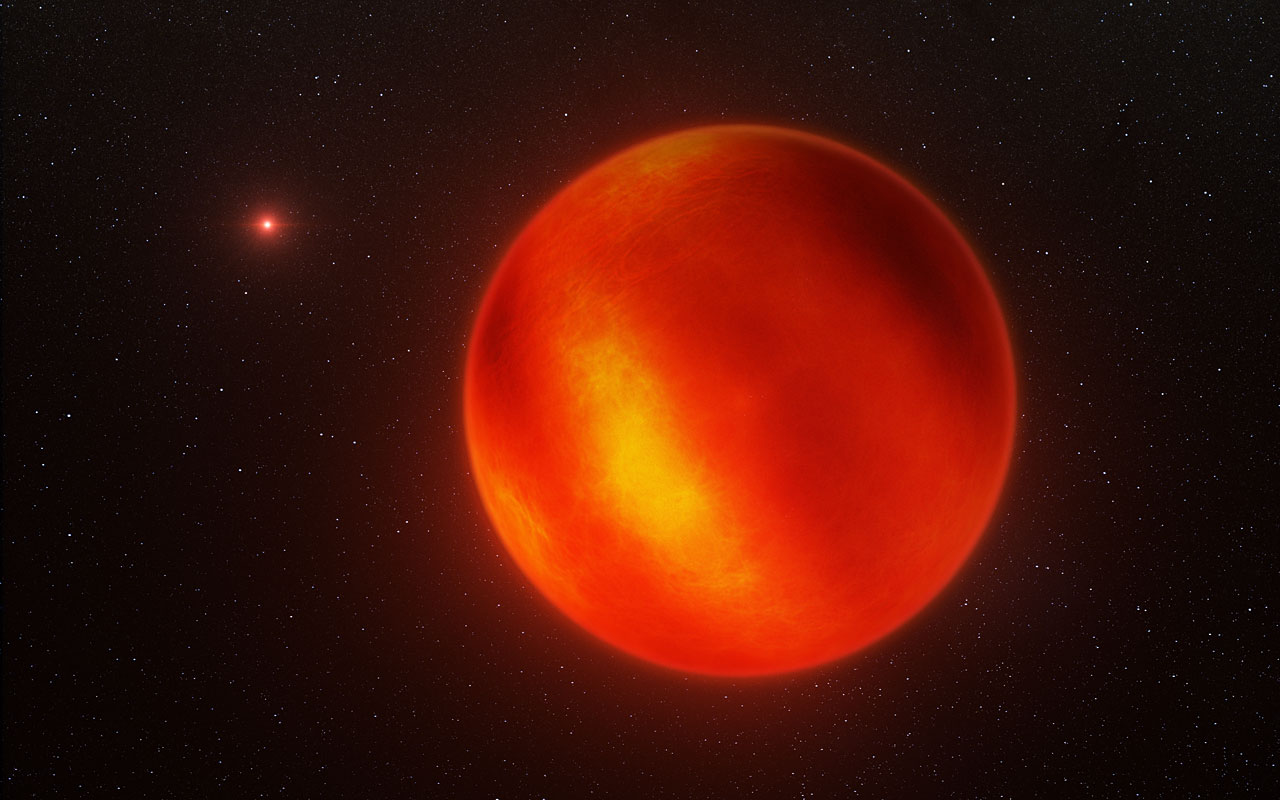 |
| Artistic rendering of clouds in the Luhman 16 system. Credit: ESO/I. Crossfield/N. Risinger |
Brown dwarfs are failed stars in the sense that they are not large enough to fuse hydrogen in their cores like our own Sun. As such, they straddle the boundary between planets like Jupiter and faint, cool stars. Gas giant planets have been found around many stars in our Galaxy, but they are frequently hard to study given the proximity to their host stars. Brown dwarfs provide an alternative as they can be studied more carefully without worrying about a bright star being too close.
One aspect of giant planet and brown dwarf science that has been active of late has been the study of their atmospheres. To this effort, Dr. Ian Crossfield, of the Max Planck Institute for Astronomy, and his team have created an impressively detailed map of the closest brown dwarf system we know.
Saturday, January 18, 2014
Astronomy: The 223rd American Astronomical Society Meeting

Last week, I was at the 223rd meeting of the American Astronomical Society (AAS). Now, I'm back in Chile and have finally written up a post about my experiences there. It's taken a while to write this up, mainly because I got very excited for some of my science at the meeting, but more on that later. Now, without further ado is a brief discussion of my time at the meeting and why I always enjoy it.
Wednesday, November 20, 2013
Astronomy: Comet ISON in Chile
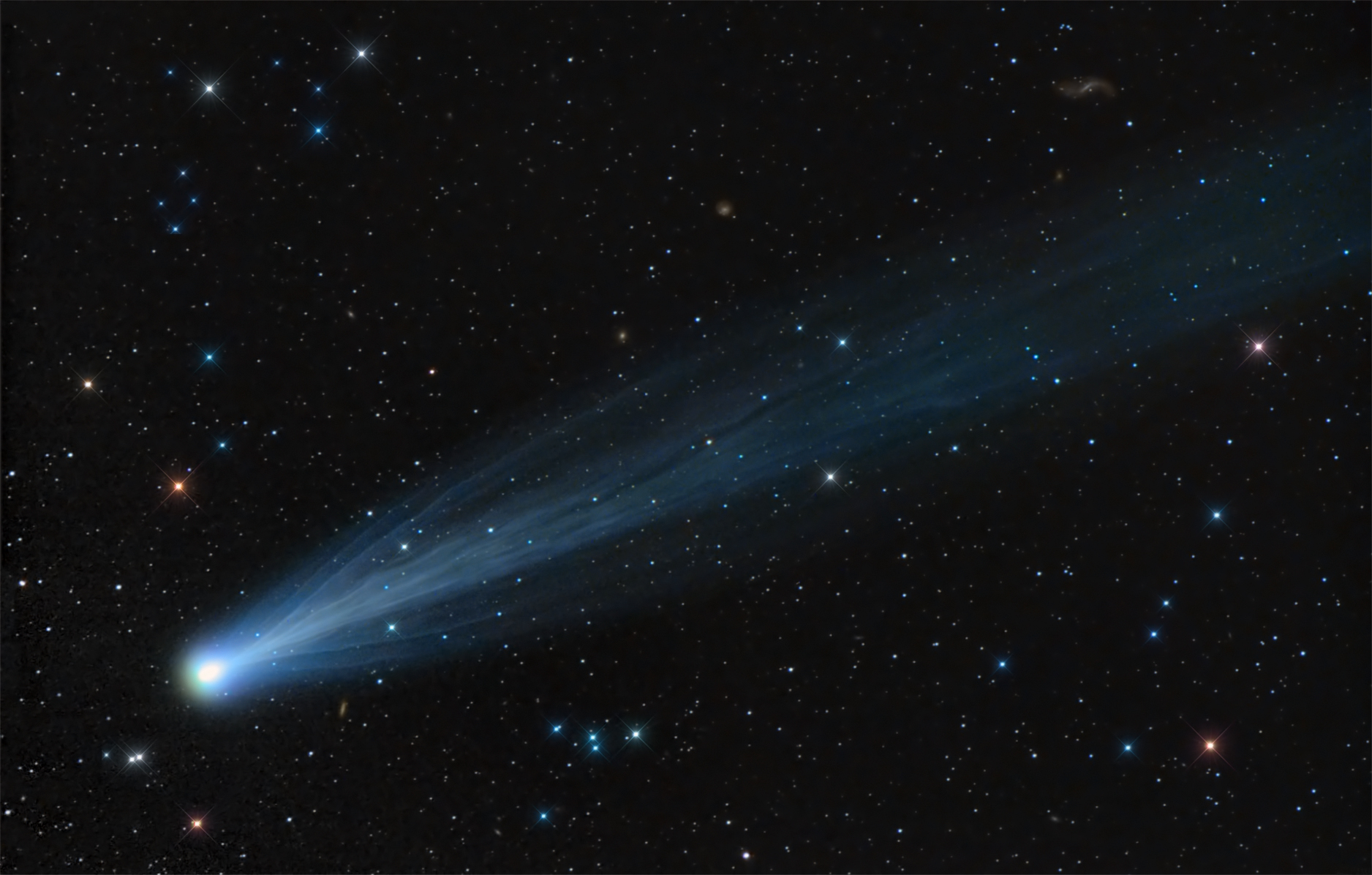 |
| Comet ISON, on November 15. Credit: Damian Peach |
There's been a lot of news lately about the brightening of Comet ISON. If it survives its close passage to the Sun on November 28, it may grow even brighter and so it's receiving some attention. However, most of the information I've seen has been for observers in the Northern Hemisphere. I figured I'd see what I could figure out about observing comet ISON from Chile. Unfortunately, things don't look too promising for the Southern Hemisphere.
For the details, read on.
Saturday, October 12, 2013
Astronomy and Middle Earth

I recently came across the above image and a post about astronomy within J.R.R. Tolkien's Lord of the Rings series. It's fascinating how much detail Tolkien included in his works. Astrophysics professor Dr. Kristine Larsen figured out the structure of the Tolkien's solar system, as well as numerous astronomical objects, by looking through all the hints in his books. The figure above illustrates that very nicely (though apparently Nénar and Luinil cannot be Uranus and Neptune given that these are actually very faint; what they are are supposed to represent has yet to be determined).
Many of our constellations are named after Greek mythological figures, the planets in our solar system carry the names of Roman gods, and new dwarf planets and Kuiper belt objects are being named for Polynesian gods. Astronomy and mythology have gone hand in hand for ages so it's nice to see that a modern fantasy mythology was written with plenty of attention to astronomical details.
A very long discussion on Tolkien's astronomy can be read here.
Saturday, September 21, 2013
Astronomy: Observing at VLT

A few weeks past, I went up to Cerro Paranal to observe with the Very Large Telescope (VLT). I was there with my officemate, Jackie Faherty, who was the PI of the program. Given that this was our first experience with the instrument (FORS2), I tagged along to learn about it and to help in any way that I could.
This blog recounts our brief adventure there.
Subscribe to:
Posts (Atom)