Last week, I visited Flagstaff, Arizona to attend the 18th meeting of the "Cambridge Workshop on Cool Stars, Stellar Systems, and the Sun" more commonly known as "Cool Stars 18." This was an excellent conference and is probably the best I've ever been to. Despite being well focused on the field, there was still so much to see and learn. Furthermore, Flagstaff was a great city and I enjoyed my time there.
Here I summarize some of my thoughts on the meeting.
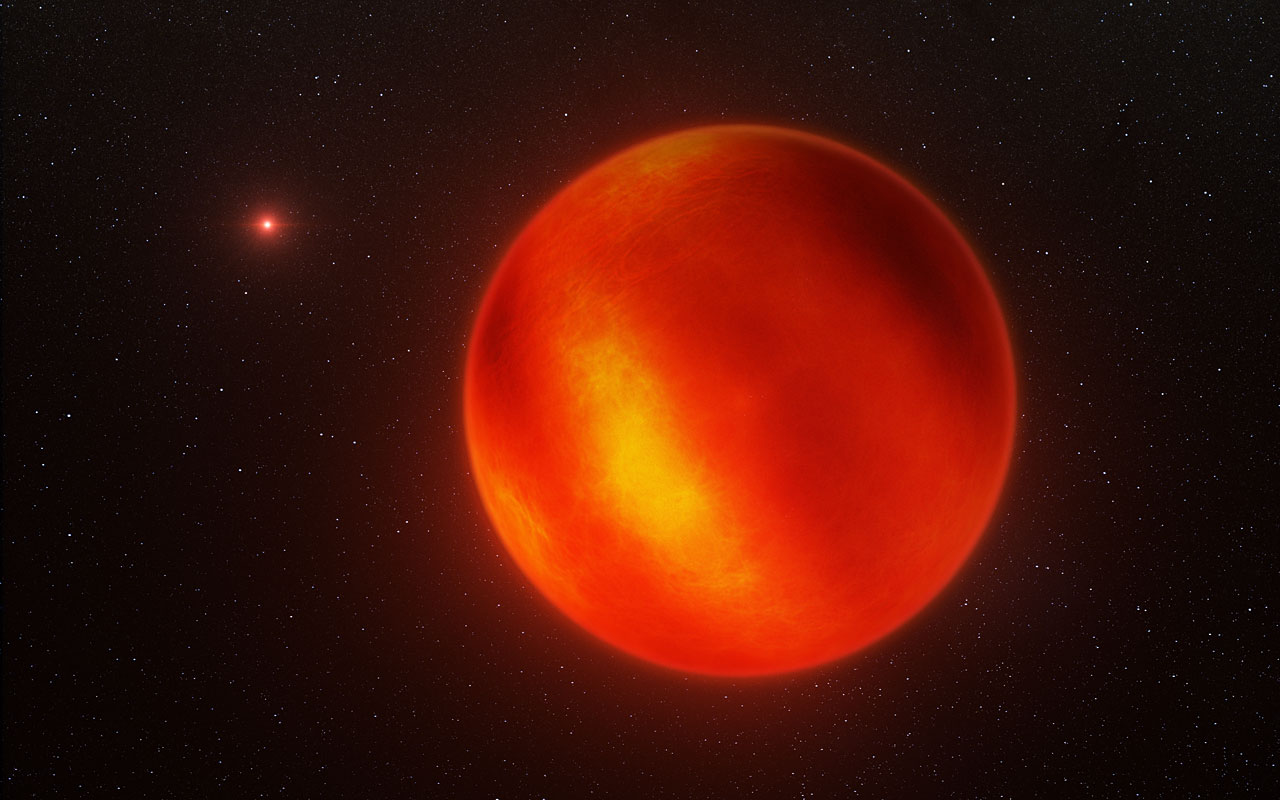
Artistic rendering of clouds in the Luhman 16 system. Credit: ESO/I. Crossfield/N. Risinger
Brown dwarfs are failed stars in the sense that they are not large enough to fuse hydrogen in their cores like our own Sun. As such, they straddle the boundary between planets like Jupiter and faint, cool stars. Gas giant planets have been found around many stars in our Galaxy, but they are frequently hard to study given the proximity to their host stars. Brown dwarfs provide an alternative as they can be studied more carefully without worrying about a bright star being too close.
One aspect of giant planet and brown dwarf science that has been active of late has been the study of their atmospheres. To this effort, Dr. Ian Crossfield, of the Max Planck Institute for Astronomy, and his team have created an impressively detailed map of the closest brown dwarf system we know.
Artistic depiction of the view from Gliese 667Cd. Credit: ESO/M. Kornmesser
The recent news is that 2 more planets in the Habitable Zone of the star Gliese 667 (aka GJ667) have just been discovered. These are GJ667C f and e. I had previously written about GJ667Cc, another habitable world in the same system. It appears that this star system could host 3 planets that, if the conditions are right, could harbor liquid water on the surface of the planet.
These planets join a growing list of potentially habitable planets.
The figure above shows a dozen planets thought to be most likely to be habitable. Note that a few, like Gliese 581g, are unconfirmed.
The planets are ranked by the "Earth Similarity Index" or ESI, which I recently learned is an index that measures how similar a planet is to the Earth. It compares the radius, density, surface temperature, and escape velocity to that of Earth's and values close to 1 are very good (ie, Earth-like). I was surprised to see escape velocity among the parameters (since it depends on the mass and radius) given that the density, which also folds in the mass and radius, is already considered.
Note that despite the high temperature on the surface of Venus, the mass and radius are so similar to the Earth that the ESI is close to 0.8. However, Venus is not in the habitable zone as it's too close to the Sun.
This is an exciting time for planetary research in astronomy as more and more planets are being discovered and we are starting to probe planets whose conditions may be favorable for liquid water and ultimately, we hope, for life.
In the latest astronomy-related news, a pair of planets in the habitable zone of a distant star has been found by NASA's Kepler spacecraft. Tons of newspapers and websites are reporting on Kepler 62. We already have several promising planets in the habitable zones of other stars, but it's a good thing to excite the public's interest in such topics. In our current times of budget cuts, it's important to emphasize the role science and astronomy have in our lives and our culture.
In addition to the reports on the planetary system, the New York Times released an impressive visualization/infographic of many of the Kepler planets discovered to date. It's very much like the older Kepler orrery, but this one is interactive so you can see extra information on the system like the name, any artist conception, or any article associated with it. Go check it out!
Nine years ago, on January 25, 2004 Universal Time (the 24th on Pacific Standard Time), the Opportunity rover landed on Mars.
To celebrate the occasion, Space.com has created this very cool infographic:
This is showing how much we (including our robots) have travelled on distant worlds, in particular Mars and the Moon. Now, we've sent landers to other worlds, such as Venus and Titan (largest moon of Saturn), but these others couldn't move around.
Opportunity, in the past nine years, has travelled over 22 miles. And the coolest thing: it's still working! Nine years in Mars and still going strong when it was made to last just over 90 days. Curiosity, our newest Mars rover, is nuclear powered and expected to last 2 (Earth) years. Its power supply, however, could let it work for many more years if nothing goes wrong.
Let's hope Opportunity and Curiosity last for many more years and keep doing great science on Mars!
This is a short post to let you know that the results of the Hetu'u Global Network have been officially published in Astronomy Education Review (AER)! You can see the article here.
More details after the jump.
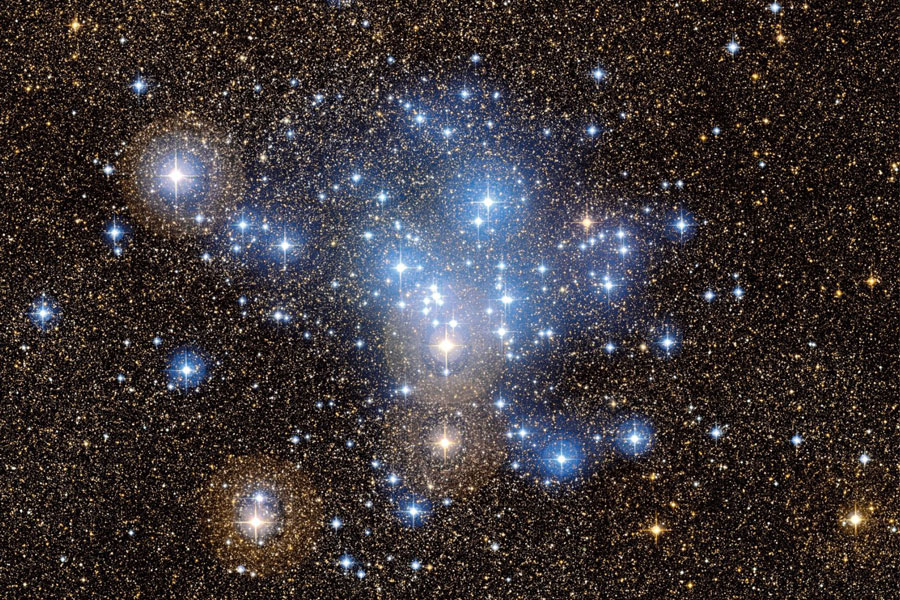
Open cluster M25. Credit: J.-C. Cuillandre (CFHT), G. Anselmi (Coelum Astronomia), Hawaiian Starlight
Stars are born in groups, as clusters of stars. Some groups stay well-knit and the members remain together many hundreds of millions of years later. Others, however, are loosely bound to each other, and, after traveling a bit through the Galaxy, get dispersed. However, the initial bulk motion of the stars in these groups is preserved. So, if you search carefully, you can find groups of widely separated stars throughout the sky all moving in approximately the same direction and with the same properties like age and composition. These are stellar moving groups, and here I'm going to tell you why astronomers love them.
A really cool new planet discovery has been announced today and I wanted to mention it here for those who haven't heard about it yet.
You may recall the Kepler Space Telescope has been starring at a patch of sky to look for periodic dips in the light of distant stars. Such dips can be caused when planets orbiting those stars transit in front of the star (just like our own Venus transit a few months back). There are so many stars to look through, though, that there is a public program available for anyone interested to look at the data. That's right: ordinary people can look at scientific data and help find planets. This Planet Hunters program is ongoing and has already discovered several planets.
Today, a really cool planet has been discovered by these citizen scientists. Read on to learn more.
If you're interested in astronomy, you're probably aware that we know of hundreds of extrasolar planets -- planets outside our solar system -- and that we have thousands of candidate planets. Many of these new candidates come from NASA's Kepler mission, which looked at the dimming of light when a planet passes in front of another star. By the current count, there are over 2000 such objects identified.
Many people have come up with clever ways to display these planets in a way that's fun and easy to understand. In this post I've gathered some of my favorites (mostly videos) and will walk you through what they show. Click through to check them out!
Do you know how big the Moon is compared to the other planets?
io9 recently had an article showing how the different planets would look like if they were placed at the distance the Moon is from the Earth. This is not the first time I've seen it done (I embed a video I found a few years ago), but I wanted to comment on it as well for those who may not have considered this.
Click through to find out more.
On August 6th 2012 (1:31 am EDT), the Mars Curiosity Rover, also known as the Mars Science Laboratory, lands on planet Mars. You've probably heard tons about this in the last few days. Everyone's talking about it!
I'm gathering here some links and multimedia for those who aren't yet informed of what's going on. There are several places you can see live or semi-live coverage of the landing (see the links below).
Concept art of the Mars Curiosity rover. Credit: NASA/JPL-Caltech
I wanted to write up a brief summary of my thoughts on the Cool Stars meeting, but was busy traveling and then had the ALMA proposal deadline. That's all past now, so here are some quick thoughts.
What is Cool Stars?
This is an international conference held every 2 years since 1980. The full title is the "Cambridge Workshop on Cool Stars, Stellar Systems, and the Sun" and as you can imaging it deals with stellar astronomy. The website description says it all:
Cool Stars is now a well established workshop, which gathers biennially about 400 worldwide experts in Low-Mass Stars, Solar Physics and more recently also Exoplanets, creating an stimulating cross-disciplinary exchange environment in these fields. Cool Star meetings have a long tradition of presenting cutting-edge science, as shown by outstanding results such as the discovery of the first Extrasolar Planet and the first confirmed Brown Dwarf, which were first announced in the Cool Stars 9 meeting celebrated in Florence, Italy in 1995.
Several weeks ago we were witness to one of the rarest, yet predictable, astronomical events known: the transit of Venus. The next such transit will be in the year 2117. You can always catch the next transit of Mercury, though. These are far more common with 13-14 events per century: the next one is May 9, 2016. However, you do need a telescope to see it as Mercury is much smaller.
Perhaps you are now hooked on transits and want to catch an even more exciting event. You may actually have already seen the November 2006 Mercury transit. How about a (near) simultaneous transit of both Venus and Mercury? Good luck: the next one will be around September in the year 13,425 AD.
Perhaps it's best to focus on something that may happen sooner? Enter the transit of the Earth!
If you think Mercury and Venus transiting is exciting, then check out this simulation of transit of the Earth (and Moon!)... from Mars!
This is the second of a three part post series on our recent trip to Easter Island. Previously I wrote about the outreach activities we did on the days leading up to the transit. In this post I describe the main event itself: the transit of Venus.
I've previously talked about the transit of Venus (here) and described the math involved in determining the distance (here). Hence, I'll skip the overview and jump right into the details.
This past week I've been with a group of astronomers on Easter Island to do outreach, observe the transit of Venus, and do some tourism. This is the first of a 3 post series describing our adventures. Part 1 is a description of the outreach activities we did at Easter Island. Part 2 describes our viewing of the transit of Venus along with our distance estimate, and Part 3 is about the places we visited.
Today is June 5, 2012 (for me, for others it will be June 6). This is the day that Venus passes in front of the Sun in a rare alignment resulting in a transit. This is similar to an eclipse, though Venus will only block ~1/30th of the Sun's disk. Unlike an eclipse, a transit of Venus is an extremely rare event. The next one will be more than a century from now: December 2117.
I had previously written about the transit (here) and detailed some of the math (here) involved in estimating the distance to the Sun. My prior post details one of the outreach activities I created as part of the event.
Today, this post is short and intended only to say one thing: WATCH IT!
This is a scheduled post so hopefully it goes out on time (regardless, the transit lasts for 6 hours).
If it's cloudy or you otherwise can't see the event, here's a short list of websites that will provide live webcasts so you can watch this unique event online (unfortunately, Team Hetu'u will not have a live web feed):
By now, you've probably heard about the transit of Venus on June 5-6, 2012. I wrote a short post (here) describing it and a second one (here) describing one method to estimate the distance to the Sun using the transit. Although Chile won't see the transit, a group of us will be traveling to Easter Island to watch it from there (technically *have* travelled since this post was scheduled in advance).
We've created a whole outreach plan for our time at Easter Island, which includes a two-day workshop at the local museum (with talks by the astronomers), school visits the following day, observing the partial lunar eclipse, and the transit of Venus itself on June 5.
One of the things I prepared was an activity on the scale of the solar system specifically for the residents of Easter Island.
With the upcoming transit of Venus, scientists from across the world are coordinating with groups to measure the contact times of the transit and re-measure the distance to the Sun. There are several websites (such as this one, or this one) that detail how to do this, and a nice (math heavy) paper by Mignard in 2004 (PDF file here). Many of these methods, however, require you to get the full duration of the transit or directly measure the parallax with imaging. Here I describe a much more simple method that requires you to measure only the time at ingress interior or egress interior for two locations on the Earth. This method is convenient as you don't need to witness the full transit (only ingress seen from Easter Island, for example). This is a retelling of the information derived by Udo Backhaus in this website with some added explanations.
The Spitzer Space Telescope is an orbiting satellite that takes data at near and mid infrared wavelengths. It had to be cryogenically cooled, otherwise it would detect its own heat in its instruments! Right now, the cryogen has run out so it only operates at the shortest wavelengths (3.5 and 4.6 microns), but is still useful for a lot of science ranging from brown dwarfs to exoplanets to dusty galaxies.
Today, NASA has revealed that Spitzer has detected the light from a distant super-Earth; the first ever such observed. At first I was surprised, since I had heard about Spitzer imaging a planet before (HD 209458b and TrES-1, see here), but it turns out that these were gas giant planets, not a super Earth.
On June 5/6, 2012 we will witness one of the rarest, yet predictable, astronomical phenomena: the transit of Venus.
What is a transit?
Just like the Moon will sometimes pass between the Earth and the Sun (causing a solar eclipse), so too do the planets on inferior orbits. In other words, Mercury and Venus, which orbit closer than the Earth, will sometimes appear to cross the disk of the Sun. Since the planets are farther away than the Moon and orbits are not perfectly aligned, these events are much rarer than solar eclipses.
Transits are rare since the orbit planes and planet positions do not always line up.
Venus transited the Sun back in June of 2004, here's what that looked like:
The June 2004 transit of Venus
The cycle continues 8 years later on June 2012. After that, though, you'd have to wait 105.5 years for the next transit: on December 2117, and then again 8 years later on December 2125. After that it's 121.5 years until the next one and then the cycle repeats (121.5, 8, 105.5, 8). Add up the numbers and you'll see this is a 243-year cycle. It is unlikely that anyone reading this blog today in 2012 will be alive on 2117 given the current human lifespan, so you do NOT want to miss this event.
Note that as the planet crosses the Sun it blocks out a tiny portion of the stellar disk. We're close enough to the Sun (93 million miles) that we can see the transit easily. It turns out that we can apply this same technique, though, to far more distant stars. For distant stars we can't see the disk of the star or the planet (it all just looks like a tiny point of light), but we can see how the brightness of the star changes with time. If the planet is big enough, when it crosses the star it will make the star appear just a little bit dimmer. With careful monitoring of a star's light, we can spot this change in brightness and, if periodic, infer that a planet is in the system. This can then be used to determine properties like the orbit of the planet and the planet size. This is called the transit method for extrasolar planet searches and is the way in which the Kepler spacecraft has found over a thousand candidates exoplanets.
A planet transits in front of a distant star.
Where can I watch the transit of Venus?
The transit will be visible from the majority of the planet, however the best place to look is in the middle of the Pacific ocean or in East Asia. People in North America can see the start of the event until the Sun sets, people in Europe and the Middle East can see the end of the event after sunrise.
Here in Chile, things don't look to promising but we have a plan (see below).
June 2012 transit visibility
Note that it is dangerous to look directly at the Sun! You want to make sure you have proper gear: eclipse viewing glasses, solar filters for telescopes, or project the image of the Sun to a piece of paper. You can create a simple pinhole camera with a few sheets of paper and a pin (to make the hole). Here is a PDF file with some instructions on how to do that. You can find more information on how to safely observe the Sun here.
One of the best ways to experience the transit, though, is with a locally hosted star party so you can share good equipment. Here is a good website to get additional information on the transit. You can also check out this website to find out the exact times for the transit event at any location on Earth.
Why are transits so important?
Since the invention of the telescope only 6 transits of Venus have been observed. A 7th, the first one predicted using the Laws of Gravitation, took place in 1631, but was not visible from Europe and went unobserved. The 2012 transit will be the second in this new era of rapid global communications (the prior one to 2004 was in 1882). Besides the historical importance of this rare event, there's also useful science that can be carried out, such as studying the atmosphere of Venus or characterizing the transit for extrasolar planet searches. One of the coolest (and simplest) things one can do with the transit, however, is calculate the distance between the Sun and the Earth- the Astronomical Unit (AU, see my post on distance here). The precise timing of the transit in various places on the Earth, combined with some very simple geometry, can be used to estimate this distance. The basic idea is that of parallax, just like for the definition of the parsec. Once you have that down, you get the scale of the solar system and can figure out how far away the different planets are.
UPDATE: I describe the basic math and the required measurements here.
Here is a neat video about the transit, determining the distance to the Sun, and how this all relates to the search for extrasolar planets with facilities like the Kepler Space Telescope:
What about Chile?
Our own team of Chilean astronomers will be hosting a viewing event and outreach activities (including star gazing as there's a partial lunar eclipse on June 4). This will be at Easter Island since the Chilean mainland will not be able to see the transit. I encourage you to join a viewing party, either ours in the exotic Easter Island or one close to your home. You do not want to miss this!
Details for the Easter Island event can be found here (Spanish) or here (English).
Be sure to share this (and our Facebook page) with anyone you know that might be travelling to Easter Island!