Showing posts with label Disks. Show all posts

Monday, November 5, 2012

Astronomy: Young Stellar Moving Groups

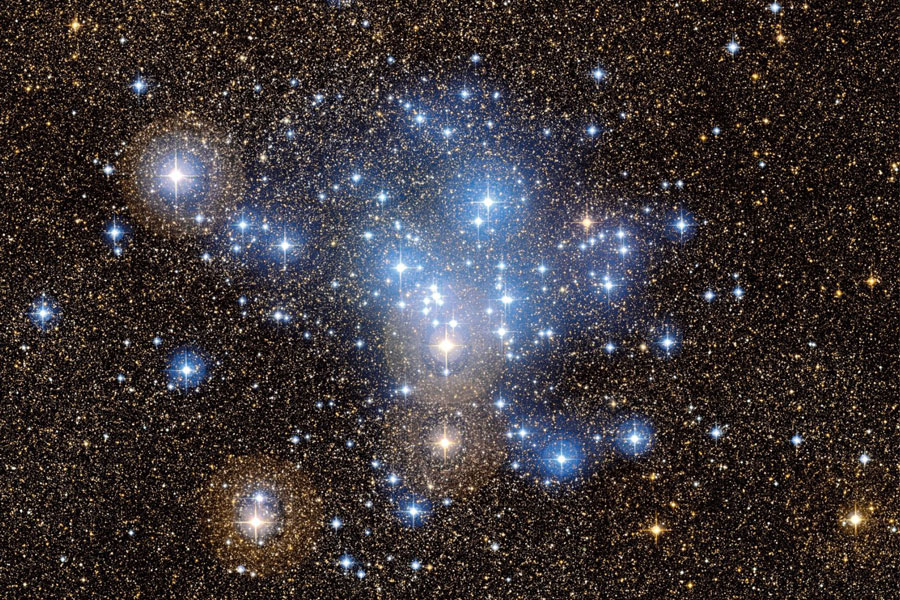
Open cluster M25. Credit:  J.-C. Cuillandre (CFHT), G. Anselmi (Coelum Astronomia), Hawaiian Starlight

Stars are born in groups, as clusters of stars. Some groups stay well-knit and the members remain together many hundreds of millions of years later. Others, however, are loosely bound to each other, and, after traveling a bit through the Galaxy, get dispersed. However, the initial bulk motion of the stars in these groups is preserved. So, if you search carefully, you can find groups of widely separated stars throughout the sky all moving in approximately the same direction and with the same properties like age and composition. These are stellar moving groups, and here I'm going to tell you why astronomers love them.

Wednesday, April 25, 2012

Astronomy: Observing at APEX

Last week, I went to San Pedro de Atacama in Northern Chile to participate in service observations at APEX Observatory. APEX stands for the Atacama Pathfinder Experiment and is a modified ALMA prototype 12-meter antenna located at the Chajnantor Plateau at a 5100-meter (16,000-feet) altitude. Like ALMA, APEX observes at submillimeter wavelengths and so requires such a high and dry site to observe.
The 12-meter diameter APEX radiotelescope

Tuesday, April 3, 2012

Astronomy: ALMA Observations of Fomalhaut

Over the last few decades, astronomy has leapt forward in leaps and bounds as new world-class facilities have been built. Large, new telescopes on the ground, such as Keck, Gemini, and VLT, or on space, like HST, Spitzer, Herschel, Chandra, and WISE, have revolutionized the way we see the universe. In the extremely arid desert of northern Chile, we are building the greatest astronomical facility on the planet to date: ALMA.

ALMA stands for the "Atacama Large Millimeter Array" and currently consists of an array of about twenty 12-meter antennas that observe the sky at submillimeter and millimeter wavelengths. When completed, it will have fifty 12-meter antennas and a more compact array of twelve 7-m and four 12-m antennas. These can be moved around to provide different baselines that result in greater resolution or greater sensitivity. ALMA observes at wavelengths of 3mm down to 400 microns, hence the 'millimeter' part of its name.
Some of the ALMA antennas already on site. Credit: NRAO/AUI and NRAO/AUI/ESO

Wednesday, March 14, 2012

WISE All-Sky Data Release

Today marks the full data release from the Wide-field Infrared Survey Explorer (WISE)! From their website:
NASA's Wide-field Infrared Survey Explorer (WISE; Wright et al. 2010) mapped the sky at 3.4, 4.6, 12, and 22 μm in 2010 with an angular resolution of 6.1" 6.4" 6.5" & 12.0" in the four bands. WISE achieved 5σ point source sensitivities better than 0.08, 0.11, 1 and 6 mJy in unconfused regions on the ecliptic in the four bands. Sensitivity improves toward the ecliptic poles due to denser coverage and lower zodiacal background.
The sky, in Galactic coordinates, according to WISE. The blue band across the image is the Milky Way Galaxy, the yellowish, diffuse band is the ecliptic- the plane of our solar system. The blue-white bands perpendicular to the ecliptic are artifacts as a result of residual Moon glow when the observations were taken.

For the non-astronomers reading this: WISE is a satellite that has mapped the sky at infrared wavelengths. Light from these wavelengths is invisible to the naked eye, but we perceive it as heat. All objects glow with light and the wavelength of peak emission depends on its temperature. For humans, with a typical temperature of 37 Celsius (98.6 Fahrenheit), the peak wavelength happens to be about 10 microns (μm). You can see that WISE probes wavelengths similar to this, so in principle it can observe objects as warm/cool as humans, though in practice these must be much physically larger in order to be detected.


There's actually a type of very cool objects out there known as brown dwarfs. Physically, these are objects that are not massive enough to have hydrogen fusion in their cores, which is the defining characteristic of a star. These brown dwarfs can range in mass from about 13 to 80 times the mass of Jupiter and are not much larger than Jupiter in size. The temperature for the coolest brown dwarfs discovered to date reaches 300 Kelvin (K). The Kelvin temperature scale is like Celsius, except shifted by 273 degrees, so this corresponds to 27 Celsius or 80 Fahrenheit.
Here are the relevant WISE temperature limits for brown dwarfs:
With WISE we will be able to see 450-K brown dwarfs out to a distance of 75 light-years (ly), 300-K brown dwarfs out to 20 ly, and 150-K brown dwarfs out to 10 ly.
That's really cool (pun intended)! 


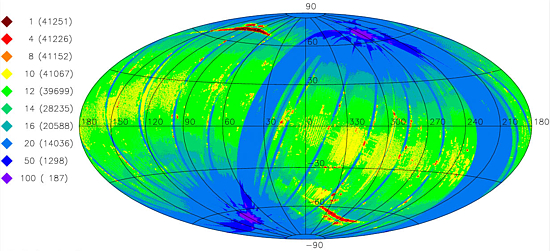
With this data release, the full WISE catalog is available to everyone. Here's a map of the WISE coverage in Equatorial coordinates (right ascension and declination, different from the figure above):
The colors indicate how often an area has been observed. The more a particular area is observed, the fainter the objects that can be detected. As you can see from the figure, most of it is green indicating WISE observed most of the sky at least 12 times. UCLA's own Ned Wright is the principle investigator (the lead scientist responsible for the project) of the WISE mission so I'm sure everyone back there must be super excited.


In addition to the brown dwarfs already mentioned, WISE has also discovered plenty of asteroids and has studied distant dusty galaxies. These wavelengths are also useful when studying warm disks around nearby stars.

Here's a video with Amy Mainzer from JPL summarizing what WISE can do:

What else WISE can find will be up to the many astronomers that will soon be diving into the WISE data release. Given that useful science is still being carried out with the Two Micron All Sky Survey (2MASS) long after its completion (2001), we can anticipate that WISE data will play a key role in the astronomical research for the next few decades.


UPDATE: Here's a link to a very nice WISE mosaic of the sky. Similar to the first figure I have, but cleaner and it identifies some of the more famous regions in the sky.
And here's a nice Flash applet that allows you to zoom in through the WISE data.

Saturday, March 10, 2012

ESO Conference: Observing Planetary Systems II

I spent 4 days this past week attending the European Southern Observatory (ESO) conference "Observing Planetary Systems II". This post is a brief summary of what went on and my thoughts during the conference.


The conference was fairly small- about 100 people or so. Compare that to the American Astronomical Society (AAS) meetings where you can have easily more than 1,000 astronomers show up. This makes finding people much easier and you interact with the same folks continuously. An additional difference is that things are much more focused: all the talks and poster were on planet, planet formation, observations (AO, infrared, sub-mm), models, disks, and all topics in between. That's a cool set of topics and everyone seems to be working on the same thing so you get some useful discussions.

There was also a small poster session. Because of so few posters, though, by day 2 one has really seen them all. Still, I tried to hang out near mine and approach people who seemed to be reading it. I'm always shy about doing so, but I try not to let that stop me. It helps that the astronomers here were cool folk and are interested in this type of research. My poster was about debris disks in binary systems. The main goal is to advance our understanding on planet formation and evolution in binary star systems.

Day 1
Some good talks, most notably the invited talks. These were longer and more big-picture type talks. As a big-picture type person I totally appreciate these overview presentations. The break-up of topics was well done. The first day focused on disks and the first few million years of planet formation, and indeed all the topics dealt with these topics.

We also got to see (again, after AAS) the Fomalhaut ALMA data. I was told by the speaker this should be submitted later this week so we may see the data soon. I'll try to write a brief post on those results when they come out.

I'm never been a big coffee person, but on conferences like these I do consume quite a bit. You really need it to stay alert after hearing 4 back-to-back talks or after 8 talks or after 14, though by then you should probably just go home as 14 was the number of talks for the first day.

Day 2
Met some more cool people and saw some nice talks, especially about efforts in the direct imaging of exoplanets, which was the main topic of the day (along with planet models). I had crafted an origami-style business card holder the prior night (thanks to this video) so I could put my brand new business cards by my poster. I got a chance to describe my research to a few more people today too.

By the end of the day I had information overload. At a larger conference I wouldn't feel too bad about skipping out on a few talks and just resting, but I wanted to hit all the talks. That's the problem with such a focused conference: everything ties together and, if you like seeing the big-picture as I do, then you want to see it all.


My poster! Pretty much recycled from AAS. The QR code points to a page on my professional website describing the research in a bit more detail along with providing links to the poster, the paper, and my other research.


Day 3
Same as the prior days in terms of talks (some good, some so-so) and meeting people. A lot of talks about our solar system; Dave Jewitt (UCLA) gave a really interesting talk on ice in the solar system. I learned a lot. Like Hilke Schlichting (also UCLA), he took the time to work out some math on the board. Is that a UCLA thing? I did my graduate studies there and took a class called Order of Magnitude Astrophysics (OoMA), which involved going up to the board and solving astronomy-related questions on the fly. This was very much like that. Both times worked very well, in my opinion.

After lunch, we switched out from the solar system and ices and into planetary atmospheres. This isn't my field of expertise and I'd already heard some of the topics back in the US among my UCLA colleagues.

Day 4
I missed the first half of the day since I was running some errands. This is related to something really cool I'll be doing at the end of the month so expect some awesome pictures then. This meant, though, that I missed the talks on biomarkers (signatures of life on other worlds), which should have been interesting. Coincidentally, one of the talks was, and I kid you not, by John Carter on Mars. I did a double take when reading the schedule given the fact that the movie was coming out that day here in Chile and it concerns a man of the same name (John Carter) and Mars. I honestly hope he had some good jokes or humor regarding the connection between them in his talk.

The afternoon session focused on some of the future instruments and surveys coming online that will help find planets. The talks were a bit diverse and I think this was mostly just the overflow of those talks that didn't quite fit anywhere else. Still, there were some interesting talks.

The conference room while at a coffee break.


Final Thoughts
Overall, the conference was good. I enjoyed most the review talks, especially those about topics only tangentially related to what I do. I learned a lot of interesting facts and concepts in these. The individual topic talks were sometimes good, but it depended a lot on the speaker. A few speakers were clearly enthusiastic whereas others just looked tired. The talks will eventually be posted on the conference website in case you want to check them out.

While there weren't a lot of brand new results, there were still many interesting facts/concepts that I either didn't know or didn't appreciate before. Here are a few that stood out:

  • The inward migration of Neptune is believed to have stirred up the planetesimal population in the Kuiper belt preventing the run-away growth phase and causing collisions to be destructive. This prevented any other large planets from forming out there. 
  • Angular differential imaging (ADI), a technique used to search for faint planets around nearby stars, can significantly affect extended structures, such as disks. Potential effects include producing warps, overly bright disk midplanes, or cavities in the disk.
  • A giant planet survey with the Gemini NICI imager suggests that less than 10% of solar type stars have giant planets of more than 4 times Jupiter's mass at separations larger than 10 AU.
  • Single power law models for planet characteristics among radial velocity detected planets cannot be extended to the directly imaged planets. Our understanding is still incomplete and/or these two techniques probe different populations of planets.
  • The Kozai mechanism, in which a 3rd object in a system (say a distant secondary star or planet) causes the eccentricity and inclination of the 2nd object (say a planet around the primary star) to oscillate, also works in the case of an inclined planet crossing a disk. Dynamical friction will dampen the inclination oscillations, though the disk can dissipate before it is fully damped.
  • The ~1m/s limit on radial velocity planet searches is driven by intrinsic stellar phenomena. Data analysis techniques, such as binning the data, can be used to get higher precisions.
  • There's both crystalline ice (like the type on your freezer) and amorphous ice, where the molecules are randomly arranged. Amorphous ice can very quickly, and explosively if it has trapped gases, convert to crystalline ice if it has enough energy or it gets warm enough. At 100 Kelvin (-173 Celsius, -280 Fahrenheit), the transformation takes only a millisecond.
  • At any given time, there are 1-2 1-meter size 'mini-Moons' sharing the Earth's orbit for a period of a few months. Much larger mini-Moons, say 100-meters, only share the orbit once every 100,000 years. These larger objects would be visible to the naked eye. Note that these mini-Moons are not truly bound to the Earth and are just passing through.

 The best quote from the conference:
Planets are more exciting than galaxies.
  - Dave Jewitt

Sunday, January 15, 2012

Planets in Binary Star Systems

The Kepler space telescope has been staring at a patch of sky to look for the dimming of light when a planet passes in front of a star. One of the interesting results coming from Kepler is the discovery of planets orbiting pairs of stars, more commonly known as binaries. These circumbinary planets are exciting because star formation tends to produce stars in pairs or groups. These binary stars are common, so finding planets among them is encouraging as it suggests planetary systems are also quite common. In this blog post I'll talk about some of the recent Kepler results and prior research on planet formation in binary star systems.
The Kepler-35 system. Credit: Lynette Cook / extrasolar.spaceart.org

How do planets form?
Planets are believed to form in gas and dust disks around stars. When we first started thinking on how the Earth and the solar system formed we realized that all the planets lie roughly in the same plane, what we call the ecliptic. The big planets were far from the Sun, whereas the smaller ones were close in. We developed the disk hypothesis to explain this scenario. Here's how it goes: the early Sun was surrounded by a disk of gas and dust. The material in the disk was used to form planets, but far from the early Sun the disk temperatures were low allowing many ices like water ice and carbon dioxide ice to exist. This facilitated the formation of large planets like Jupiter and Saturn, whereas close to the Sun the disk lacked these ices and the planets, like Earth and Venus, ended up smaller. Since the planets all formed from the disk, they all share the same plane, similar to the rotation axis of the Sun, all as a consequence of conservation of angular momentum.

This picture is nice and simple, but it has been challenged since we started finding planets in the mid-90s. One of the first problems was that most extrasolar planets (or exoplanets) orbited very close to their stars, but were very massive. These 'hot Jupiters', as they are called, have masses comparable to that of Jupiter in our own solar system, but orbit much closer than Mercury is to the Sun, whipping around their stars in a matter of days. For comparison, Mercury takes 88 Earth-days to go around the Sun, whereas Jupiter takes about 11 Earth-years. These hot Jupiter are very easy to detect and so were the first such exoplanets detected. We've revised the disk model of planet formation to include things like planet migration, where planets form far away and drift inwards, to explain how these objects form.

The HAT-P-11 system.
Credit: Subaru Telescope,
National Astronomical Observatory of Japan (NAOJ)
More recently, we've started to measure the plane of exoplanet orbits relative to the spin axis of their stars. We expected these to be aligned, but much to our surprise some systems are very different or are orbiting in the opposite fashion as the star is spinning. This again challenges the simple disk model I outlined in the first paragraph. Planets migrating inward wouldn't change their orbital plane, so perhaps dynamical interaction between multiple planets is more important here.


As more and more planets are discovered, we find new ways to challenge our models. This is how science grows: we develop a model, test it, and refine it, continuing until we can satisfactorily explain the phenomenon we observe. Here's one other system that's difficult to explain:
The Kepler-20 system. Credit: David A. Aguilar (CfA)
Kepler-20 depicted above hosts 5 planets, but the radius and masses of these cycle between big and small rather than having all of them nearly equal size or having them segregated by mass. This is yet another scenario that challenges our ideas on planet formation.
But enough about planet formation, let's talk about binaries.

What do we know about disks in binary systems?
Many young stars possess these gas and dust disks, also known as protoplanetary disks. Furthermore, roughly half of all stars are in binary or multiple systems. These systems possess more than one main star and the secondary star(s) will influence the formation and evolution of any other objects in the system.

Theoretical and numerical studies suggest that secondary stars will disperse protoplanetary disks as the gravitational influence of the secondary creates gaps or truncates the disks. This has also been seen in observations. Studies of binary protoplanetary systems do show lower disk masses than around single stars and more widely separated binaries. The cutoff appears to be in binaries with separations of 100 astronomical units or less. An astronomical unit, or AU, is the distance between the Earth and the Sun and corresponds to about 150 million kilometers. This defines the scales for studies of planetary systems and disk studies. For comparison, in our solar system Mercury is at 0.39 AU and Neptune is at 30 AU from the Sun.

My own research has dealt with debris disks, which are older disks on planetary evolution timescales. I wrote a brief blog post about debris disks some time ago. They also show similar trends as the younger protoplanetary disks and are consistent with the theoretical picture. Most stellar binaries have separations of order 20-40 AU and would very readily disrupt any disks forming in the system. If a planet is to form in a binary system, the two stars must be very widely separated (hundreds of AU) or very closely separated.
The V4046 Sgr circumbinary disk; the two stars are 0.04 AU apart. 
Credit: David A. Aguilar (CfA)

Are any planets known in binary systems?
This is the big question and we already know the answer to it: YES. While many studies avoid searching for planets in binary systems (due to the complications these pose), about 10-20% of planet bearing stars have a more distant companion. These companions tend to be very widely separated so it's unlikely that they have influenced the evolution of the system in any significant way. For a long time, it seemed that the secondary stars were at least 20 AU away from the primary, and more usually at least 100 AU. However, there were a few cases were circumbinary planets were announced. These only increased in number with Kepler.

Circumbinary planets and Kepler results
A handful of circumbinary planet candidates were known prior to Kepler. These were discovered by looking at eclipsing binaries and accurately timing the eclipses. If you understand the system well, you can accurately predict when one star or the other passes in front of, or eclipses, the other. However, in a few cases the eclipse did not occur at the expected time. There is a discrepancy between the observed and calculated eclipse time which suggest something else is in the system. An unseen planet, for example, can tug on the stars and mess up the timing. This is an indirect probe of the system, as the planet is not actually observed.

Kepler searches for planets by staring at stars and monitoring how bright they are. When a planet passes in front of the star, or transits, the star will become slightly fainter. Kepler has detected thousands of candidate planets and many of those are being confirmed as true planetary systems. One particularly exciting planet system, in my opinion, is Kepler-16, depicted below.
The Kepler-16 system. Credit: NASA/JPL-Caltech/T. Pyle
Kepler-16 was the first case where a planet was seen to transit two stars, which also mutually eclipse one another. This is undeniable evidence for a circumbinary planet. The two stars are separated by only 0.2 AU, but the planet is more than 3 times farther away with an orbit at 0.7 AU. The system is quite compact, but the stars are smaller than the Sun so the temperature of the planet (and any moons) is likely to be too cold to support liquid water and life as we know it. Since then, Kepler has discovered two more circumbinary planets: Kepler-34b and Kepler-35b. It looks like circumbinary planets aren't so rare after all!

While more and more circumbinary planets are being found, we're finding that these follow the theoretical expectations and disk observations. That is, the stars are very closely separated compared to the planet location. Hence, planets like Star Wars' Tatooine, may form out there if a planet-forming disk surrounds a very close pair of stars. Considering the fact that hundred of billions of planets may be in our galaxy (see here), then even with the restrictions imposed by a secondary star, there must be millions of circumbinary planets out there.

Bad Astronomy has an article on the Kepler-34 and 35 systems (also Kepler-16) in case you want to do further reading.

Monday, January 9, 2012

Astronomy: Debris Disks

I figured I'd make a post about some cool things in astronomy, particularly those relevant to my own research. Today's topic: debris disks.

While writing this I realize the topic is far too broad to give it justice, but hopefully you'll get a flavor for what these are and why they are so cool.

Artists conception of HD 98800
Credit: NASA/JPL-Caltech/T. Pyle (SSC)

So what are debris disks? 
The short definition is that these are rings or disks of dust grains surrounding a star. Think of them like Saturn's rings, except on a much larger scale. Read on to learn more.

How can we find these disks and rings?
The trick to finding them, is to look at systems in infrared light. What we see with our eyes is, aptly named, visible light. When you go outside and see your friends, you are seeing visible light from the Sun, the Moon, or nearby artificial sources reflecting off of your friends. In complete darkness you would not be able to see them without some equipment, like heat-vision goggles or infrared cameras.
We humans have a body temperature of about 310 Kelvin (98.6 Farenheit), which means we glow at a wavelength of 12 microns. Visible light, in comparison, has wavelengths of 0.4-0.7 microns or so. Hence we cannot see our own glow without specialized instruments. The peak wavelength an object emits depends on its temperature. A hot object, like a lightbulb's filament or the surface of the Sun and other stars, will emit light near the visible range. Colder objects, like our bodies, emit at longer wavelengths and thus in the infrared and submillimeter range. The dust grains constituting debris disks can be as warm as 300 K, but are generally colder than 100 K. To observe these systems we need to look at light in the 20-500 micron range.

Here is what the sky looks like at 100 microns:
Credit: R. Hurt/IRAS/DIRBE, see here
As you can probably tell, the sky looks very different from what you are used to. What we see is the cool dust spread throughout the galaxy; we barely see any stars at all. The Galactic plane runs horizontal across the image and we can see a few nearby star forming regions- Ophiucus is near the center and above the plane, Taurus is at the left, Orion at the right, and some galaxies- the two blobs below the plane midway to the right are the Large and Small Magellanic Clouds, nearby galaxies to our own Milky Way.

Stars barely produce any light at these wavelengths; their emission peaks in the visible, remember? Hence, we can look at where the stars are supposed to be and see if there is any light at 100 microns (or any other such long wavelength). Sometimes we see that there is indeed light coming at those wavelengths. By looking at multiple long wavelengths (say 12, 25, 60, 100, etc, microns) we can reconstruct what's going on and say 'something of temperature X is present around this star'. As we've learned, this is a disk or ring of dust surrounding the system.

Where does the dust come from?
This is an interesting question as there are two possible answers. The first is that the dust is primordial material, that is, it is left over from the star formation process. This will generally be the case for the very youngest stars. However, stars are very effective at clearing out the system of dust. In only a few thousand years the dust grains should be cleared out, though the timescale depends greatly on the properties of the star, the removal mechanism, and the dust grain sizes. Most stars, however, are hundreds of millions of years old and are not expected to have any material leftover from the star formation process. In this case, the dust we see has been recently (or continuously) produced by collisions of rocky objects. For example, asteroids or Kuiper belt objects, when they collide, will produce dust. If enough of these collisions occur, then a detectable debris disk emerges in the system.

Can we actually see these disks?
In many cases, the resolving power of the far-infrared instruments we've used to find these disks is not sufficient to actually produce an image. What we see is just a blob and can't tell if there is any structure there. However, for the systems closest to the Earth, or those with the largest disks, we've been able to actually produce an image of the disk. In some cases, we can also see the disk in visible or shorter-wavelength infrared light, when the grains reflect the light of the star. This tends to produce some of the nicest images we have.
Here are a couple of debris disks seen with the Hubble Space Telescope:


Does our own solar system have a debris disk?
Our solar system has tons of small objects (asteroids, comets, and Kuiper belt objects). When these collide they produce dust; however, collisions are much less frequent today than they were billions of years ago when the solar system was young. Hence, the amount of dust is minute. Our telescopes are capable of detecting dust in distant star systems if it these contain substantial quantities of dust, say at least 100 times that of our own solar system (though if I recall correctly, the Herschel spacecraft does get close enough to the expected contribution from the Kuiper belt). So detecting an analog to our own solar system from afar is not feasible with our current technology. However, we are embedded in our system and thus have a much closer view. Collisions and comets have produced dust in our system that we can see as the zodiacal light:
Credit: Bob King / Duluth News Tribune
You need to be in a very dark sky to see this triangular wedge of light. You'll spot it right after sunset or right before sunrise. I must admit to never having seen the zodiacal light, though I've been in dark observation sites.

What about planets?
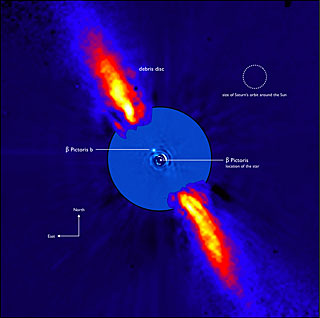
Planets are one of the hottest things in astronomy right now. Everyone is talking about them, especially the public. Debris disks indirectly suggest planets, or at least planetesimals like asteroids, exist or have existed in distant stars. This is encouraging as it's easier to spot debris disks than it is to search for planets. Furthermore, the properties of the disk can suggest a nearby planet. For example, gaps, warps, or offsets in imaged disks or rings can suggest an unseen object (ie, a planet) is tugging the material to produce these features. This was the case for the beta Pictoris star system, where a secondary dust disk was observed in the central regions. A close examination revealed a massive planet in the system:
Credit: ESO/A.-M. Lagrange et al.

My own research:
One particular line of study I've done is to explore how often binary or multiple stars, that is star systems with two stars or more, possess debris disks. It should not come as a surprise that a second (or third, etc) star will disrupt the system. While planets are known to exist in these multiple star systems, they are mostly found around either very widely separated stars, so that the gravitational influence of the second star is minimal; or around very tightly spaced stars, so that the planet effectively sees them as just one object. For intermediate separations, say a second star located at Saturn's orbit in our own solar system, the second star would completely disrupt the disk preventing a solar system-analog from forming.

Finishing thoughts:
Debris disks are cool. They are a by-product of planet formation and their study allows us to explore how planets like our own are formed. As a bonus, they are also really neat when imaged. For now, all we can do for planets is get a tiny point of light, but for nearby disks we can get the whole structure.

I hope to do more of these astronomy posts from time to time, and perhaps to revisit debris disks in a more focused post. Stay tuned for a brief summary of my impressions of the American Astronomical Meeting #219 in Austin, TX.