Over the past few weeks, I've been playing a bit with some NoSQL databases, in particular, with MongoDB. This is one particular type of database known as a document-store database and it works primarily by saving JSON formatted 'documents'. While exploring this technology and working on some Python code, I realized how easy it is to convert a standard Python class into a dictionary and how dictionaries readily translate into JSON. With this knowledge in hand, a light-bulb went off in my head as I realized I could make use of the new dataclasses implemented as part of Python 3.7 and quickly create a working database with minimal code.
In this post, I'll describe some of the ideas I had in mind while working through this and, if you want to try this on your own, I can point you to this Jupyter notebook where I work out this example.
Showing posts with label Brown Dwarfs. Show all posts
Showing posts with label Brown Dwarfs. Show all posts
Saturday, May 18, 2019

Wednesday, June 18, 2014
Astronomy: Cool Stars 18 Meeting

Here I summarize some of my thoughts on the meeting.
Wednesday, January 29, 2014
Astronomy: Cloudy Weather on a Nearby Brown Dwarf
 |
| Artistic rendering of clouds in the Luhman 16 system. Credit: ESO/I. Crossfield/N. Risinger |
Brown dwarfs are failed stars in the sense that they are not large enough to fuse hydrogen in their cores like our own Sun. As such, they straddle the boundary between planets like Jupiter and faint, cool stars. Gas giant planets have been found around many stars in our Galaxy, but they are frequently hard to study given the proximity to their host stars. Brown dwarfs provide an alternative as they can be studied more carefully without worrying about a bright star being too close.
One aspect of giant planet and brown dwarf science that has been active of late has been the study of their atmospheres. To this effort, Dr. Ian Crossfield, of the Max Planck Institute for Astronomy, and his team have created an impressively detailed map of the closest brown dwarf system we know.
Sunday, July 15, 2012
Astronomy: Cool Stars 17 Meeting
I wanted to write up a brief summary of my thoughts on the Cool Stars meeting, but was busy traveling and then had the ALMA proposal deadline. That's all past now, so here are some quick thoughts.
What is Cool Stars?
This is an international conference held every 2 years since 1980. The full title is the "Cambridge Workshop on Cool Stars, Stellar Systems, and the Sun" and as you can imaging it deals with stellar astronomy. The website description says it all:
What is Cool Stars?
This is an international conference held every 2 years since 1980. The full title is the "Cambridge Workshop on Cool Stars, Stellar Systems, and the Sun" and as you can imaging it deals with stellar astronomy. The website description says it all:
Cool Stars is now a well established workshop, which gathers biennially about 400 worldwide experts in Low-Mass Stars, Solar Physics and more recently also Exoplanets, creating an stimulating cross-disciplinary exchange environment in these fields. Cool Star meetings have a long tradition of presenting cutting-edge science, as shown by outstanding results such as the discovery of the first Extrasolar Planet and the first confirmed Brown Dwarf, which were first announced in the Cool Stars 9 meeting celebrated in Florence, Italy in 1995.
Monday, April 9, 2012
Astronomy: MOSFIRE First Light
MOSFIRE, or the Multi-Object Spectrometer For Infra-Red Exploration, has seen first light at W.M. Keck Observatory. This is means the instrument was mounted on the 10-meter diameter Keck I telescope and took its first images of the night sky. It's a big step as it shows that things are moving along.
The MOSFIRE instrument had been under construction at UCLA during my time there and several of my friends worked on it. It is good to see their efforts paid off and the instrument is online and will soon be taking data.
The MOSFIRE instrument had been under construction at UCLA during my time there and several of my friends worked on it. It is good to see their efforts paid off and the instrument is online and will soon be taking data.
Wednesday, March 14, 2012
WISE All-Sky Data Release
Today marks the full data release from the Wide-field Infrared Survey Explorer (WISE)! From their website:
For the non-astronomers reading this: WISE is a satellite that has mapped the sky at infrared wavelengths. Light from these wavelengths is invisible to the naked eye, but we perceive it as heat. All objects glow with light and the wavelength of peak emission depends on its temperature. For humans, with a typical temperature of 37 Celsius (98.6 Fahrenheit), the peak wavelength happens to be about 10 microns (μm). You can see that WISE probes wavelengths similar to this, so in principle it can observe objects as warm/cool as humans, though in practice these must be much physically larger in order to be detected.
There's actually a type of very cool objects out there known as brown dwarfs. Physically, these are objects that are not massive enough to have hydrogen fusion in their cores, which is the defining characteristic of a star. These brown dwarfs can range in mass from about 13 to 80 times the mass of Jupiter and are not much larger than Jupiter in size. The temperature for the coolest brown dwarfs discovered to date reaches 300 Kelvin (K). The Kelvin temperature scale is like Celsius, except shifted by 273 degrees, so this corresponds to 27 Celsius or 80 Fahrenheit.
Here are the relevant WISE temperature limits for brown dwarfs:
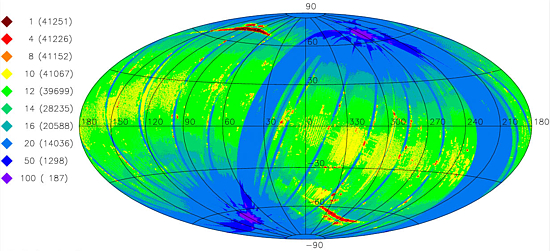
With this data release, the full WISE catalog is available to everyone. Here's a map of the WISE coverage in Equatorial coordinates (right ascension and declination, different from the figure above):
 The colors indicate how often an area has been observed. The more a particular area is observed, the fainter the objects that can be detected. As you can see from the figure, most of it is green indicating WISE observed most of the sky at least 12 times. UCLA's own Ned Wright is the principle investigator (the lead scientist responsible for the project) of the WISE mission so I'm sure everyone back there must be super excited.
In addition to the brown dwarfs already mentioned, WISE has also discovered plenty of asteroids and has studied distant dusty galaxies. These wavelengths are also useful when studying warm disks around nearby stars.
Here's a video with Amy Mainzer from JPL summarizing what WISE can do:
What else WISE can find will be up to the many astronomers that will soon be diving into the WISE data release. Given that useful science is still being carried out with the Two Micron All Sky Survey (2MASS) long after its completion (2001), we can anticipate that WISE data will play a key role in the astronomical research for the next few decades.
UPDATE: Here's a link to a very nice WISE mosaic of the sky. Similar to the first figure I have, but cleaner and it identifies some of the more famous regions in the sky.
And here's a nice Flash applet that allows you to zoom in through the WISE data.
NASA's Wide-field Infrared Survey Explorer (WISE; Wright et al. 2010) mapped the sky at 3.4, 4.6, 12, and 22 μm in 2010 with an angular resolution of 6.1" 6.4" 6.5" & 12.0" in the four bands. WISE achieved 5σ point source sensitivities better than 0.08, 0.11, 1 and 6 mJy in unconfused regions on the ecliptic in the four bands. Sensitivity improves toward the ecliptic poles due to denser coverage and lower zodiacal background.
 |
| The sky, in Galactic coordinates, according to WISE. The blue band across the image is the Milky Way Galaxy, the yellowish, diffuse band is the ecliptic- the plane of our solar system. The blue-white bands perpendicular to the ecliptic are artifacts as a result of residual Moon glow when the observations were taken. |
For the non-astronomers reading this: WISE is a satellite that has mapped the sky at infrared wavelengths. Light from these wavelengths is invisible to the naked eye, but we perceive it as heat. All objects glow with light and the wavelength of peak emission depends on its temperature. For humans, with a typical temperature of 37 Celsius (98.6 Fahrenheit), the peak wavelength happens to be about 10 microns (μm). You can see that WISE probes wavelengths similar to this, so in principle it can observe objects as warm/cool as humans, though in practice these must be much physically larger in order to be detected.
There's actually a type of very cool objects out there known as brown dwarfs. Physically, these are objects that are not massive enough to have hydrogen fusion in their cores, which is the defining characteristic of a star. These brown dwarfs can range in mass from about 13 to 80 times the mass of Jupiter and are not much larger than Jupiter in size. The temperature for the coolest brown dwarfs discovered to date reaches 300 Kelvin (K). The Kelvin temperature scale is like Celsius, except shifted by 273 degrees, so this corresponds to 27 Celsius or 80 Fahrenheit.
Here are the relevant WISE temperature limits for brown dwarfs:
With WISE we will be able to see 450-K brown dwarfs out to a distance of 75 light-years (ly), 300-K brown dwarfs out to 20 ly, and 150-K brown dwarfs out to 10 ly.That's really cool (pun intended)!
With this data release, the full WISE catalog is available to everyone. Here's a map of the WISE coverage in Equatorial coordinates (right ascension and declination, different from the figure above):
In addition to the brown dwarfs already mentioned, WISE has also discovered plenty of asteroids and has studied distant dusty galaxies. These wavelengths are also useful when studying warm disks around nearby stars.
Here's a video with Amy Mainzer from JPL summarizing what WISE can do:
What else WISE can find will be up to the many astronomers that will soon be diving into the WISE data release. Given that useful science is still being carried out with the Two Micron All Sky Survey (2MASS) long after its completion (2001), we can anticipate that WISE data will play a key role in the astronomical research for the next few decades.
UPDATE: Here's a link to a very nice WISE mosaic of the sky. Similar to the first figure I have, but cleaner and it identifies some of the more famous regions in the sky.
And here's a nice Flash applet that allows you to zoom in through the WISE data.
Subscribe to:
Posts (Atom)