Last week, I visited Flagstaff, Arizona to attend the 18th meeting of the "Cambridge Workshop on Cool Stars, Stellar Systems, and the Sun" more commonly known as "Cool Stars 18." This was an excellent conference and is probably the best I've ever been to. Despite being well focused on the field, there was still so much to see and learn. Furthermore, Flagstaff was a great city and I enjoyed my time there.
Here I summarize some of my thoughts on the meeting.
Random thoughts from a book-loving Puerto Rican astronomical data scientist in Baltimore.
Showing posts with label Stars. Show all posts
Wednesday, June 18, 2014
Monday, November 5, 2012
Astronomy: Young Stellar Moving Groups
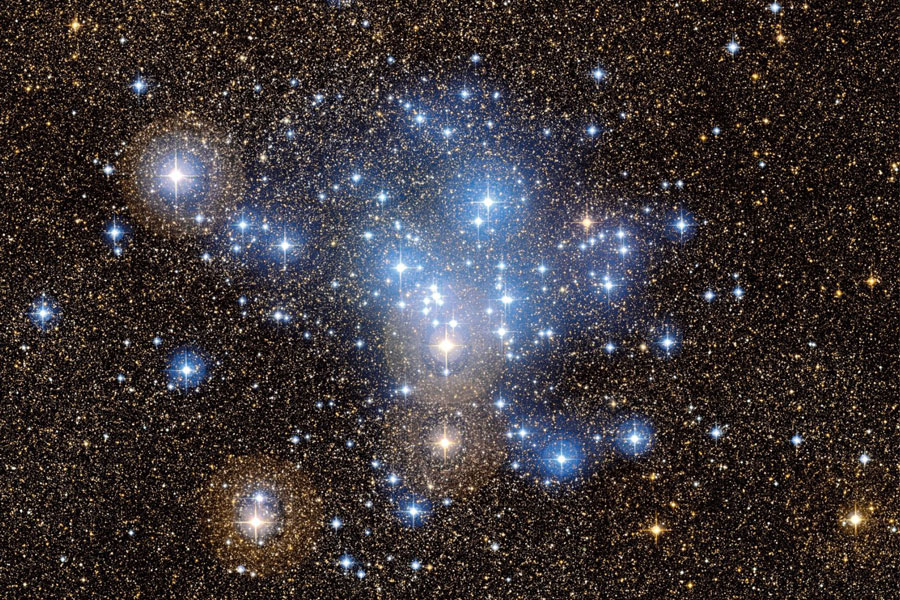
| Open cluster M25. Credit: J.-C. Cuillandre (CFHT), G. Anselmi (Coelum Astronomia), Hawaiian Starlight |
Stars are born in groups, as clusters of stars. Some groups stay well-knit and the members remain together many hundreds of millions of years later. Others, however, are loosely bound to each other, and, after traveling a bit through the Galaxy, get dispersed. However, the initial bulk motion of the stars in these groups is preserved. So, if you search carefully, you can find groups of widely separated stars throughout the sky all moving in approximately the same direction and with the same properties like age and composition. These are stellar moving groups, and here I'm going to tell you why astronomers love them.
Sunday, July 15, 2012
Astronomy: Cool Stars 17 Meeting
I wanted to write up a brief summary of my thoughts on the Cool Stars meeting, but was busy traveling and then had the ALMA proposal deadline. That's all past now, so here are some quick thoughts.
What is Cool Stars?
This is an international conference held every 2 years since 1980. The full title is the "Cambridge Workshop on Cool Stars, Stellar Systems, and the Sun" and as you can imaging it deals with stellar astronomy. The website description says it all:
What is Cool Stars?
This is an international conference held every 2 years since 1980. The full title is the "Cambridge Workshop on Cool Stars, Stellar Systems, and the Sun" and as you can imaging it deals with stellar astronomy. The website description says it all:
Cool Stars is now a well established workshop, which gathers biennially about 400 worldwide experts in Low-Mass Stars, Solar Physics and more recently also Exoplanets, creating an stimulating cross-disciplinary exchange environment in these fields. Cool Star meetings have a long tradition of presenting cutting-edge science, as shown by outstanding results such as the discovery of the first Extrasolar Planet and the first confirmed Brown Dwarf, which were first announced in the Cool Stars 9 meeting celebrated in Florence, Italy in 1995.
Saturday, April 28, 2012
Transit of Venus: June 2012
On June 5/6, 2012 we will witness one of the rarest, yet predictable, astronomical phenomena: the transit of Venus.
What is a transit?
Just like the Moon will sometimes pass between the Earth and the Sun (causing a solar eclipse), so too do the planets on inferior orbits. In other words, Mercury and Venus, which orbit closer than the Earth, will sometimes appear to cross the disk of the Sun. Since the planets are farther away than the Moon and orbits are not perfectly aligned, these events are much rarer than solar eclipses.
Venus transited the Sun back in June of 2004, here's what that looked like:
The cycle continues 8 years later on June 2012. After that, though, you'd have to wait 105.5 years for the next transit: on December 2117, and then again 8 years later on December 2125. After that it's 121.5 years until the next one and then the cycle repeats (121.5, 8, 105.5, 8). Add up the numbers and you'll see this is a 243-year cycle. It is unlikely that anyone reading this blog today in 2012 will be alive on 2117 given the current human lifespan, so you do NOT want to miss this event.
Note that as the planet crosses the Sun it blocks out a tiny portion of the stellar disk. We're close enough to the Sun (93 million miles) that we can see the transit easily. It turns out that we can apply this same technique, though, to far more distant stars. For distant stars we can't see the disk of the star or the planet (it all just looks like a tiny point of light), but we can see how the brightness of the star changes with time. If the planet is big enough, when it crosses the star it will make the star appear just a little bit dimmer. With careful monitoring of a star's light, we can spot this change in brightness and, if periodic, infer that a planet is in the system. This can then be used to determine properties like the orbit of the planet and the planet size. This is called the transit method for extrasolar planet searches and is the way in which the Kepler spacecraft has found over a thousand candidates exoplanets.
Where can I watch the transit of Venus?
The transit will be visible from the majority of the planet, however the best place to look is in the middle of the Pacific ocean or in East Asia. People in North America can see the start of the event until the Sun sets, people in Europe and the Middle East can see the end of the event after sunrise.
Here in Chile, things don't look to promising but we have a plan (see below).
Note that it is dangerous to look directly at the Sun! You want to make sure you have proper gear: eclipse viewing glasses, solar filters for telescopes, or project the image of the Sun to a piece of paper. You can create a simple pinhole camera with a few sheets of paper and a pin (to make the hole). Here is a PDF file with some instructions on how to do that. You can find more information on how to safely observe the Sun here.
One of the best ways to experience the transit, though, is with a locally hosted star party so you can share good equipment. Here is a good website to get additional information on the transit. You can also check out this website to find out the exact times for the transit event at any location on Earth.
Why are transits so important?
Since the invention of the telescope only 6 transits of Venus have been observed. A 7th, the first one predicted using the Laws of Gravitation, took place in 1631, but was not visible from Europe and went unobserved. The 2012 transit will be the second in this new era of rapid global communications (the prior one to 2004 was in 1882). Besides the historical importance of this rare event, there's also useful science that can be carried out, such as studying the atmosphere of Venus or characterizing the transit for extrasolar planet searches. One of the coolest (and simplest) things one can do with the transit, however, is calculate the distance between the Sun and the Earth- the Astronomical Unit (AU, see my post on distance here). The precise timing of the transit in various places on the Earth, combined with some very simple geometry, can be used to estimate this distance. The basic idea is that of parallax, just like for the definition of the parsec. Once you have that down, you get the scale of the solar system and can figure out how far away the different planets are.
UPDATE: I describe the basic math and the required measurements here.
Here is a neat video about the transit, determining the distance to the Sun, and how this all relates to the search for extrasolar planets with facilities like the Kepler Space Telescope:
What about Chile?
Our own team of Chilean astronomers will be hosting a viewing event and outreach activities (including star gazing as there's a partial lunar eclipse on June 4). This will be at Easter Island since the Chilean mainland will not be able to see the transit. I encourage you to join a viewing party, either ours in the exotic Easter Island or one close to your home. You do not want to miss this!
Details for the Easter Island event can be found here (Spanish) or here (English).
Be sure to share this (and our Facebook page) with anyone you know that might be travelling to Easter Island!
What is a transit?
Just like the Moon will sometimes pass between the Earth and the Sun (causing a solar eclipse), so too do the planets on inferior orbits. In other words, Mercury and Venus, which orbit closer than the Earth, will sometimes appear to cross the disk of the Sun. Since the planets are farther away than the Moon and orbits are not perfectly aligned, these events are much rarer than solar eclipses.
| Transits are rare since the orbit planes and planet positions do not always line up. |
Venus transited the Sun back in June of 2004, here's what that looked like:
![]() |
| The June 2004 transit of Venus |
The cycle continues 8 years later on June 2012. After that, though, you'd have to wait 105.5 years for the next transit: on December 2117, and then again 8 years later on December 2125. After that it's 121.5 years until the next one and then the cycle repeats (121.5, 8, 105.5, 8). Add up the numbers and you'll see this is a 243-year cycle. It is unlikely that anyone reading this blog today in 2012 will be alive on 2117 given the current human lifespan, so you do NOT want to miss this event.
Note that as the planet crosses the Sun it blocks out a tiny portion of the stellar disk. We're close enough to the Sun (93 million miles) that we can see the transit easily. It turns out that we can apply this same technique, though, to far more distant stars. For distant stars we can't see the disk of the star or the planet (it all just looks like a tiny point of light), but we can see how the brightness of the star changes with time. If the planet is big enough, when it crosses the star it will make the star appear just a little bit dimmer. With careful monitoring of a star's light, we can spot this change in brightness and, if periodic, infer that a planet is in the system. This can then be used to determine properties like the orbit of the planet and the planet size. This is called the transit method for extrasolar planet searches and is the way in which the Kepler spacecraft has found over a thousand candidates exoplanets.
| A planet transits in front of a distant star. |
Where can I watch the transit of Venus?
The transit will be visible from the majority of the planet, however the best place to look is in the middle of the Pacific ocean or in East Asia. People in North America can see the start of the event until the Sun sets, people in Europe and the Middle East can see the end of the event after sunrise.
Here in Chile, things don't look to promising but we have a plan (see below).
![]() |
| June 2012 transit visibility |
Note that it is dangerous to look directly at the Sun! You want to make sure you have proper gear: eclipse viewing glasses, solar filters for telescopes, or project the image of the Sun to a piece of paper. You can create a simple pinhole camera with a few sheets of paper and a pin (to make the hole). Here is a PDF file with some instructions on how to do that. You can find more information on how to safely observe the Sun here.
One of the best ways to experience the transit, though, is with a locally hosted star party so you can share good equipment. Here is a good website to get additional information on the transit. You can also check out this website to find out the exact times for the transit event at any location on Earth.
Why are transits so important?
Since the invention of the telescope only 6 transits of Venus have been observed. A 7th, the first one predicted using the Laws of Gravitation, took place in 1631, but was not visible from Europe and went unobserved. The 2012 transit will be the second in this new era of rapid global communications (the prior one to 2004 was in 1882). Besides the historical importance of this rare event, there's also useful science that can be carried out, such as studying the atmosphere of Venus or characterizing the transit for extrasolar planet searches. One of the coolest (and simplest) things one can do with the transit, however, is calculate the distance between the Sun and the Earth- the Astronomical Unit (AU, see my post on distance here). The precise timing of the transit in various places on the Earth, combined with some very simple geometry, can be used to estimate this distance. The basic idea is that of parallax, just like for the definition of the parsec. Once you have that down, you get the scale of the solar system and can figure out how far away the different planets are.
UPDATE: I describe the basic math and the required measurements here.
Here is a neat video about the transit, determining the distance to the Sun, and how this all relates to the search for extrasolar planets with facilities like the Kepler Space Telescope:
What about Chile?
Our own team of Chilean astronomers will be hosting a viewing event and outreach activities (including star gazing as there's a partial lunar eclipse on June 4). This will be at Easter Island since the Chilean mainland will not be able to see the transit. I encourage you to join a viewing party, either ours in the exotic Easter Island or one close to your home. You do not want to miss this!
Details for the Easter Island event can be found here (Spanish) or here (English).
Be sure to share this (and our Facebook page) with anyone you know that might be travelling to Easter Island!
Tuesday, April 3, 2012
Astronomy: ALMA Observations of Fomalhaut
Over the last few decades, astronomy has leapt forward in leaps and bounds as new world-class facilities have been built. Large, new telescopes on the ground, such as Keck, Gemini, and VLT, or on space, like HST, Spitzer, Herschel, Chandra, and WISE, have revolutionized the way we see the universe. In the extremely arid desert of northern Chile, we are building the greatest astronomical facility on the planet to date: ALMA.
ALMA stands for the "Atacama Large Millimeter Array" and currently consists of an array of about twenty 12-meter antennas that observe the sky at submillimeter and millimeter wavelengths. When completed, it will have fifty 12-meter antennas and a more compact array of twelve 7-m and four 12-m antennas. These can be moved around to provide different baselines that result in greater resolution or greater sensitivity. ALMA observes at wavelengths of 3mm down to 400 microns, hence the 'millimeter' part of its name.
| Some of the ALMA antennas already on site. Credit: NRAO/AUI and NRAO/AUI/ESO |
Monday, March 19, 2012
Sunspots Group 1429
Just a quick blog post to point you to today's amazing Astronomy Picture of the Day (APOD):
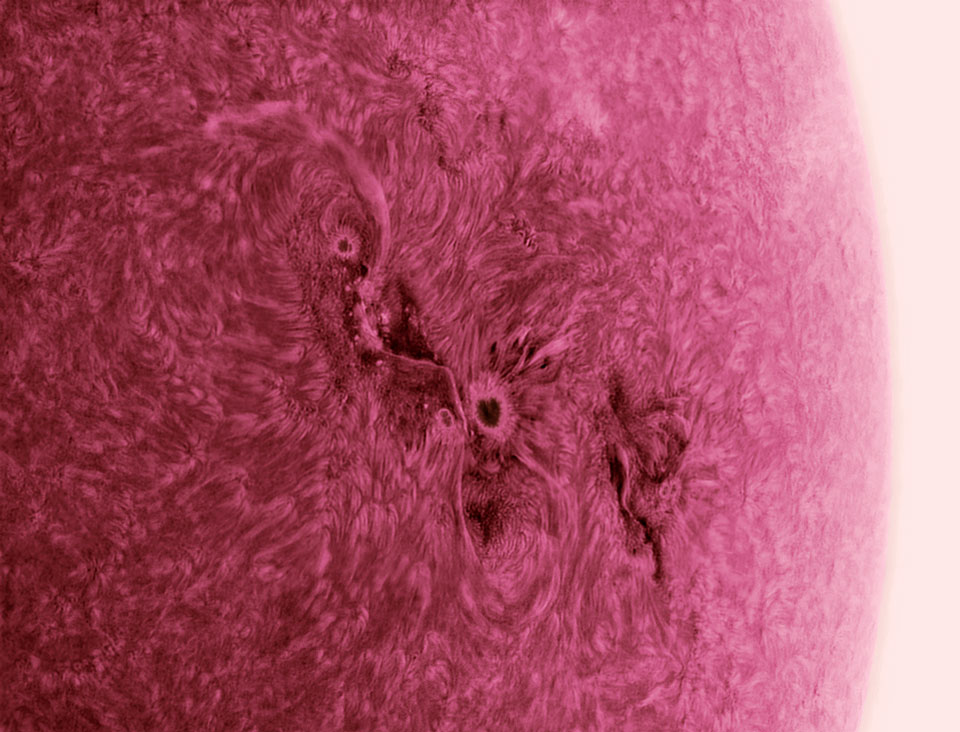
Look very carefully at that sunset picture. Ignore the birds, the tree, and the bands due to the thin clouds in our own atmosphere. On the disk of the Sun itself, you can clearly see some spots. That's not a defective camera lens, those spots are actually on the Sun. The big one there is sunspot group 1429, which you can also see in this other APOD picture:
Sunspot group 1429 is a particularly large set of sunspots that was quite active a few weeks ago. You may have heard the news of a massive solar flare emanating from this region around March 7th or so. This increase in solar activity happens periodically as the Sun reaches solar maximum.
One last thing I want to point out is the scale of these sunspots. If you look at the first image you'll see a few smallish spots near the center. Each of those is larger than the planet Earth. The Sun is big, and yet it is an average star that's just one of a hundred billion or so stars in our own Galaxy.
![]() |
| Credit: APOD, Juan Manuel Pérez Rayego |
Look very carefully at that sunset picture. Ignore the birds, the tree, and the bands due to the thin clouds in our own atmosphere. On the disk of the Sun itself, you can clearly see some spots. That's not a defective camera lens, those spots are actually on the Sun. The big one there is sunspot group 1429, which you can also see in this other APOD picture:
| Credit: APOD, Alan Friedman |
Sunspot group 1429 is a particularly large set of sunspots that was quite active a few weeks ago. You may have heard the news of a massive solar flare emanating from this region around March 7th or so. This increase in solar activity happens periodically as the Sun reaches solar maximum.
One last thing I want to point out is the scale of these sunspots. If you look at the first image you'll see a few smallish spots near the center. Each of those is larger than the planet Earth. The Sun is big, and yet it is an average star that's just one of a hundred billion or so stars in our own Galaxy.
Wednesday, March 14, 2012
WISE All-Sky Data Release
Today marks the full data release from the Wide-field Infrared Survey Explorer (WISE)! From their website:
For the non-astronomers reading this: WISE is a satellite that has mapped the sky at infrared wavelengths. Light from these wavelengths is invisible to the naked eye, but we perceive it as heat. All objects glow with light and the wavelength of peak emission depends on its temperature. For humans, with a typical temperature of 37 Celsius (98.6 Fahrenheit), the peak wavelength happens to be about 10 microns (μm). You can see that WISE probes wavelengths similar to this, so in principle it can observe objects as warm/cool as humans, though in practice these must be much physically larger in order to be detected.
There's actually a type of very cool objects out there known as brown dwarfs. Physically, these are objects that are not massive enough to have hydrogen fusion in their cores, which is the defining characteristic of a star. These brown dwarfs can range in mass from about 13 to 80 times the mass of Jupiter and are not much larger than Jupiter in size. The temperature for the coolest brown dwarfs discovered to date reaches 300 Kelvin (K). The Kelvin temperature scale is like Celsius, except shifted by 273 degrees, so this corresponds to 27 Celsius or 80 Fahrenheit.
Here are the relevant WISE temperature limits for brown dwarfs:
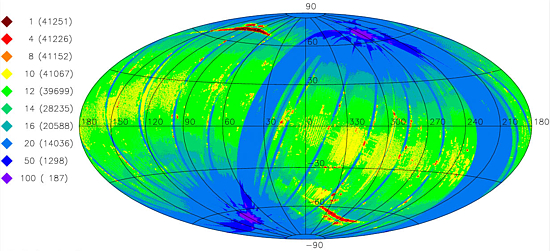
With this data release, the full WISE catalog is available to everyone. Here's a map of the WISE coverage in Equatorial coordinates (right ascension and declination, different from the figure above):
The colors indicate how often an area has been observed. The more a particular area is observed, the fainter the objects that can be detected. As you can see from the figure, most of it is green indicating WISE observed most of the sky at least 12 times. UCLA's own Ned Wright is the principle investigator (the lead scientist responsible for the project) of the WISE mission so I'm sure everyone back there must be super excited.
In addition to the brown dwarfs already mentioned, WISE has also discovered plenty of asteroids and has studied distant dusty galaxies. These wavelengths are also useful when studying warm disks around nearby stars.
Here's a video with Amy Mainzer from JPL summarizing what WISE can do:
What else WISE can find will be up to the many astronomers that will soon be diving into the WISE data release. Given that useful science is still being carried out with the Two Micron All Sky Survey (2MASS) long after its completion (2001), we can anticipate that WISE data will play a key role in the astronomical research for the next few decades.
UPDATE: Here's a link to a very nice WISE mosaic of the sky. Similar to the first figure I have, but cleaner and it identifies some of the more famous regions in the sky.
And here's a nice Flash applet that allows you to zoom in through the WISE data.
NASA's Wide-field Infrared Survey Explorer (WISE; Wright et al. 2010) mapped the sky at 3.4, 4.6, 12, and 22 μm in 2010 with an angular resolution of 6.1" 6.4" 6.5" & 12.0" in the four bands. WISE achieved 5σ point source sensitivities better than 0.08, 0.11, 1 and 6 mJy in unconfused regions on the ecliptic in the four bands. Sensitivity improves toward the ecliptic poles due to denser coverage and lower zodiacal background.
For the non-astronomers reading this: WISE is a satellite that has mapped the sky at infrared wavelengths. Light from these wavelengths is invisible to the naked eye, but we perceive it as heat. All objects glow with light and the wavelength of peak emission depends on its temperature. For humans, with a typical temperature of 37 Celsius (98.6 Fahrenheit), the peak wavelength happens to be about 10 microns (μm). You can see that WISE probes wavelengths similar to this, so in principle it can observe objects as warm/cool as humans, though in practice these must be much physically larger in order to be detected.
There's actually a type of very cool objects out there known as brown dwarfs. Physically, these are objects that are not massive enough to have hydrogen fusion in their cores, which is the defining characteristic of a star. These brown dwarfs can range in mass from about 13 to 80 times the mass of Jupiter and are not much larger than Jupiter in size. The temperature for the coolest brown dwarfs discovered to date reaches 300 Kelvin (K). The Kelvin temperature scale is like Celsius, except shifted by 273 degrees, so this corresponds to 27 Celsius or 80 Fahrenheit.
Here are the relevant WISE temperature limits for brown dwarfs:
With WISE we will be able to see 450-K brown dwarfs out to a distance of 75 light-years (ly), 300-K brown dwarfs out to 20 ly, and 150-K brown dwarfs out to 10 ly.That's really cool (pun intended)!
With this data release, the full WISE catalog is available to everyone. Here's a map of the WISE coverage in Equatorial coordinates (right ascension and declination, different from the figure above):
The colors indicate how often an area has been observed. The more a particular area is observed, the fainter the objects that can be detected. As you can see from the figure, most of it is green indicating WISE observed most of the sky at least 12 times. UCLA's own Ned Wright is the principle investigator (the lead scientist responsible for the project) of the WISE mission so I'm sure everyone back there must be super excited.
In addition to the brown dwarfs already mentioned, WISE has also discovered plenty of asteroids and has studied distant dusty galaxies. These wavelengths are also useful when studying warm disks around nearby stars.
Here's a video with Amy Mainzer from JPL summarizing what WISE can do:
What else WISE can find will be up to the many astronomers that will soon be diving into the WISE data release. Given that useful science is still being carried out with the Two Micron All Sky Survey (2MASS) long after its completion (2001), we can anticipate that WISE data will play a key role in the astronomical research for the next few decades.
UPDATE: Here's a link to a very nice WISE mosaic of the sky. Similar to the first figure I have, but cleaner and it identifies some of the more famous regions in the sky.
And here's a nice Flash applet that allows you to zoom in through the WISE data.
Monday, February 27, 2012
Supernova 1987A
Very massive stars, those that are at least 8 times the mass of the Sun, explode as supernova when they die. Note that the Sun WILL NOT do this, nor will most of the stars of the Galaxy. Only the rare, massive stars go supernova. The mechanics of how supernova work is still an active area of research and has to deal with the physics going on in the core of the star.
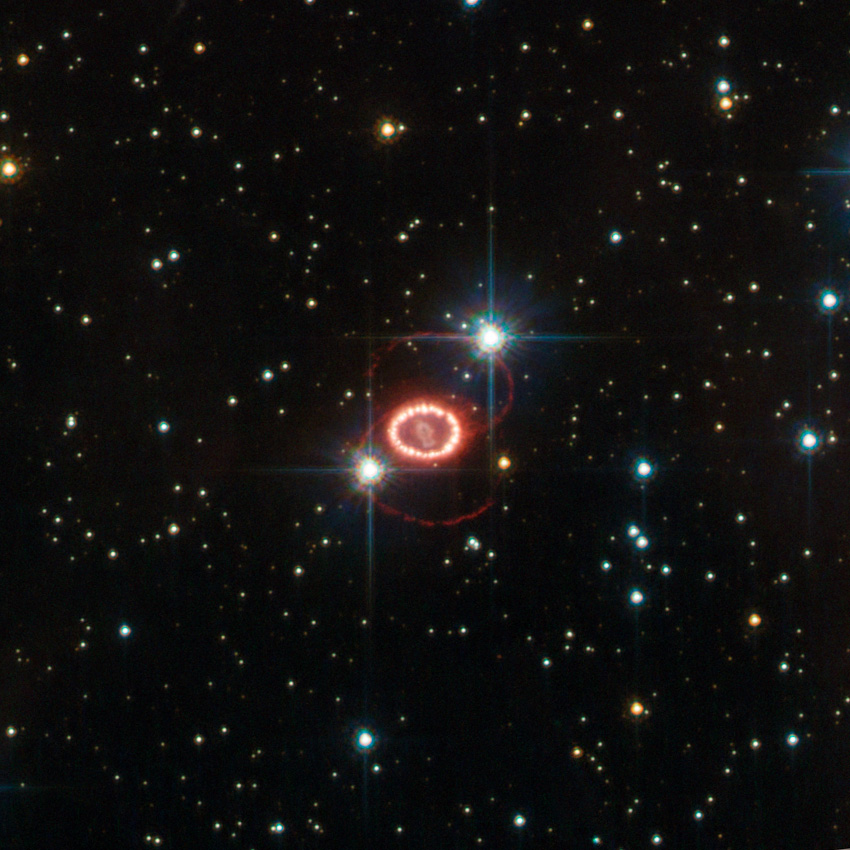
One particularly famous supernova is SN 1987A, so named because it was the first (A) supernova (SN) observed in the year 1987. This is the brightest and closest supernova to go off in modern times. The event went off in the Large Magellanic Cloud, our nearby satellite galaxy which is visible from the Southern Hemisphere. The distance is approximately 51.4 kiloparsecs from Earth or 168,000 light-years (remember your distance units?). It was close enough, and in a well studied region, that we have identified the progenitor star before it went supernova- it was a blue supergiant star.
At that time, neutrino detectors had recently been constructed on Earth and this is the first, and thus far only, time in which neutrinos have been detected from an astronomical source other than the Sun. About 2 dozen neutrinos were detected from SN 1987A and, from what I understand, these have resulted in hundreds of papers concerning neutrino and supernova astronomy. This makes SN 1987A one of the most famously studied supernova of all times.
But what are neutrinos? Neutrinos are extremely tiny, electrically neutral particles that barely interact with anything- trillions of neutrinos pass through your body each second and yet none of them interact or affect your body in any way! These elusive particles are produced in nuclear processes such as radioactive decay and nuclear fusion. Well, fusion is exactly what's going on inside of stars that allows them to shine and hold them up against their own gravity. Neutrinos are also a natural by-product of supernova and its expected that the energy carried by neutrinos exceeds the energy the supernova emits as light (approximately all the light the Sun will produce over its entire lifetime!) by a factor of 100 or so.
Why all this talk about SN 1987A? The Astronomy Picture of the Day (APOD) has been putting up cool images on SN1987A for the past few days. The first is depicted at the beginning of this post. Here is the second:
This very cool animation depicts how the central source has dimmed and, more importantly, how material from that source has reached and impacted the ring of material around the source and caused it to glow. The origin of the ring, this small one (whose diameter is about 1.3 lightyears) and the larger figure-8 pattern on the other image, still remains a mystery. These rings existed BEFORE the supernova and have been lit-up by the light and particles that have reached them.
I'm no supernova astronomer, but even I think SN 1987A is cool and I'm glad these really neat images are out there for the public (and scientists) to enjoy.
| The remnant of SN 1987A. Credit: ESA/Hubble, NASA (link) |
One particularly famous supernova is SN 1987A, so named because it was the first (A) supernova (SN) observed in the year 1987. This is the brightest and closest supernova to go off in modern times. The event went off in the Large Magellanic Cloud, our nearby satellite galaxy which is visible from the Southern Hemisphere. The distance is approximately 51.4 kiloparsecs from Earth or 168,000 light-years (remember your distance units?). It was close enough, and in a well studied region, that we have identified the progenitor star before it went supernova- it was a blue supergiant star.
At that time, neutrino detectors had recently been constructed on Earth and this is the first, and thus far only, time in which neutrinos have been detected from an astronomical source other than the Sun. About 2 dozen neutrinos were detected from SN 1987A and, from what I understand, these have resulted in hundreds of papers concerning neutrino and supernova astronomy. This makes SN 1987A one of the most famously studied supernova of all times.
But what are neutrinos? Neutrinos are extremely tiny, electrically neutral particles that barely interact with anything- trillions of neutrinos pass through your body each second and yet none of them interact or affect your body in any way! These elusive particles are produced in nuclear processes such as radioactive decay and nuclear fusion. Well, fusion is exactly what's going on inside of stars that allows them to shine and hold them up against their own gravity. Neutrinos are also a natural by-product of supernova and its expected that the energy carried by neutrinos exceeds the energy the supernova emits as light (approximately all the light the Sun will produce over its entire lifetime!) by a factor of 100 or so.
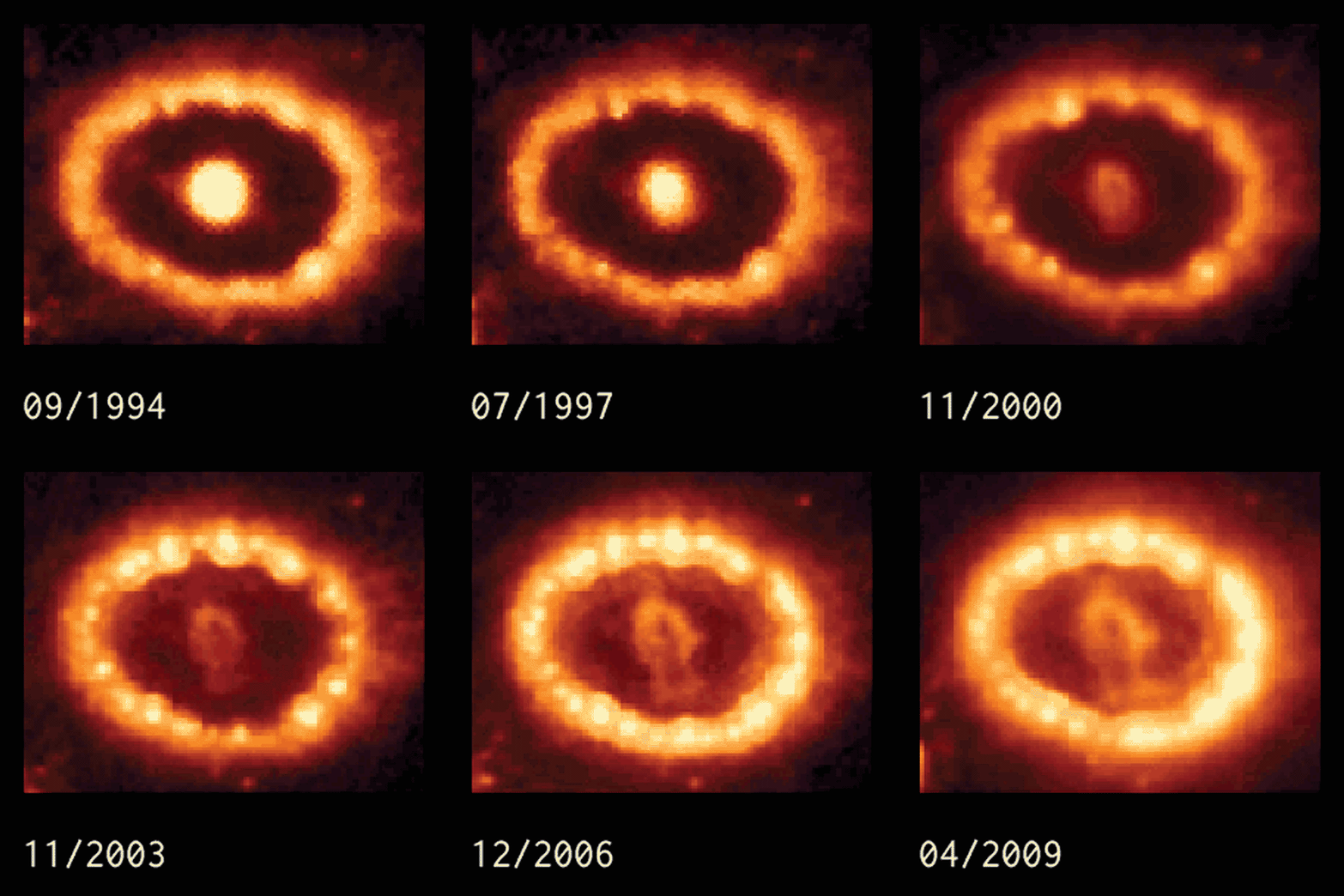
Why all this talk about SN 1987A? The Astronomy Picture of the Day (APOD) has been putting up cool images on SN1987A for the past few days. The first is depicted at the beginning of this post. Here is the second:
| Animation of the core of SN1987A from 1994 to 2009. Credit: Hubble Space Telescope, NASA, ESA; Video compilation: Mark McDonald (link) |
This very cool animation depicts how the central source has dimmed and, more importantly, how material from that source has reached and impacted the ring of material around the source and caused it to glow. The origin of the ring, this small one (whose diameter is about 1.3 lightyears) and the larger figure-8 pattern on the other image, still remains a mystery. These rings existed BEFORE the supernova and have been lit-up by the light and particles that have reached them.
I'm no supernova astronomer, but even I think SN 1987A is cool and I'm glad these really neat images are out there for the public (and scientists) to enjoy.
Saturday, January 28, 2012
Solar Activity
Over the past few weeks I've heard a bit of talk on the Sun and its recent activity. So I figure I'd give a short description of what's going on.
Why is the Sun active?
Most of the time the Sun sits there quietly producing light. However, from time to time, parts on the surface of the Sun will suddenly increase, or flare, in brightness. A lot of light, usually in the form of ultraviolet (UV) and X-ray radiation is produced, but charged particles like electrons, protons, and other ions are also ejected in these events. Flares occur when charged particles are accelerated with the help of magnetic fields in the region. The amount of energy involved is huge, at least thousands of times the entire nuclear arsenal in our planet, and produce the high energy light that we see and accelerate particles that travel 150 million kilometers before reaching the Earth. These flares occur in sunspot groups on the surface of the Sun.
Sunspots are so called because they appear darker than the rest of the Sun. They are much cooler than the rest of the Sun with temperatures of order 3000 Kelvin (2727 Celsius, 4940 Farenheit). In comparison, the rest of the Sun is about 6000 Kelvin. So to say that they are 'cool' is only relative- the surface, or photosphere, of the Sun is quite hot whether or not you are in a sunspot. These spots are actually quite large, the smallest are about the size of the Earth, with many being many Earth-diameters across. The Sun is absolutely huge when compared to our planet: just over a hundred Earth's would be needed to span the Sun's diameter. These sunspot groups are the sites of strong magnetic activity and can lead to flare events or coronal mass ejections (similar explosions that eject a large amount of material out to space). Here is a satellite ultraviolet image of the solar flare event that took place January 27, 2012:
One thing to bear in mind is that the Sun has an 11-year sunspot cycle. At some times we are at solar minimum with very few sunspots and associated activity (like solar flares). At others, we are at solar maximum and can expect lots of sunspots and flares. The peak in solar activity was supposed to occur sometime around 2011, but the cycle can be a bit irregular. It looks like now things are starting to warm up and we can expect a peak in activity around 2013 and 2014.
How does this affect the Earth?
During a flare event, UV and X-ray emission is produced. However, compared to other stars (see below) this isn't a huge amount. Also, the Earth's atmosphere is very good at blocking this high-energy radiation. You've probably heard of the ozone layer. This is a layer in the Earth's atmosphere which serves to stop most of the harmful UV light from reaching the surface. In fact, when astronomers want to study stars or galaxies at these wavelengths they have to use satellites in order to avoid the blocking effect of Earth's atmosphere.
However, in addition to the light there are also high-energy particles- protons, electrons, and a few small nuclei, that are produced. As these are particles, they cannot travel at the speed of light and take a bit longer, usually a few days, to reach the Earth. When they do, they encounter two things around the Earth- the magnetosphere and the atmosphere.
The Earth is surrounded by a magnetic field, what we refer to as the magnetosphere, produced in the interior of the planet. Many of the solar system's planets, and even some of the moons, are known to possess these magnetic fields. These magnetic fields interact with charged particles (protons, electrons, etc) and deflect their paths. Some of these charged particles become trapped in the magnetic field and are channeled to the north and south magnetic poles. There they slam into the Earth's atmosphere.
The result, is the aurora. The impact of the charged particles on oxygen and nitrogen atoms cause these to emit light. Because of the magnetosphere's influence, though, these lights only are seen near the Earth's poles and so are generally called northern (or southern) lights. Or in more technical terms- the aurora borealis and aurora australis. During very strong (and rare) solar flares, these may occur much farther from the poles and be visible at latitudes closer to the equator.
The aurora are harmless and serve to remind us that life on Earth is protected from these cosmic events by a variety of mechanisms. The same, though, cannot be said for electronic equipment. Satellites in high Earth orbit are not as well protected and can be damaged by the incoming particles (the same would be true of astronauts far from Earth). If you know something of electromagnetic theory, you'll remember that a wire passed under a magnetic field will have a current induced on it. A strong solar storm will induce currents on electric grids on Earth, which can destroy power transformers and cause widespread blackouts.
Flares on Other Stars
Other stars also experience flares, particularly low-mass stars or young ones. As mentioned before, the mechanism behind producing such activity is tied to the magnetic fields at the surface of the star. The mechanism that controls the strength of such fields involves the rotation of the star and the convection going on in the outer layers. Well, it turns out that stars rotate faster when they are young and they continuously slow down as they age. Also, stars of lower mass have much larger convective envelopes. In fact, once you get below a certain mass, the entire star is fully convective. There is indeed a class of star, flare stars, that are known to undergo these events quite frequently. They can also be more energetic than our Sun- the energy released in a flaring event can be about a hundred times more than that released by a Sun's flare.
One particular project I've worked on is the search for young, low-mass stars. We make use of precisely this mechanism to search for candidates: young, low mass stars should be bright in UV and X-ray light. By looking at X-ray and UV source catalogs we can identify nearby stars that exhibit too much emission and can observe them in more detail to figure out what's going on. In many cases, these turn out to indeed be young, low-mass stars. Why is searching for young, low-mass stars important? You'll have to wait for a future blog post to find out...
What does this imply about life around flare stars?
This is actually a big issue in ongoing discussions. Lower mass stars are more common than higher mass ones. An active area of research is to figure out how often planets form in stars of different masses. Most initial studies focused on solar type stars, but we've since expanded to searching for planets among lower and higher mass stars. Even without a good handle on frequency of planets as a function of stellar mass, though, one would still expect that many planets could be around potentially active, low mass stars.
More telling, however, are the requirements for life around these worlds. In order to have life similar to that of Earth's, water is a key requirement. However, these lower mass stars do not produce the same amount of light as the Sun. Hence, a planet would have to be much closer to the star in order to be warm enough to have liquid water on it's surface. That certainly can happen, but we're considering stars that can potentially flare up and release X-ray and UV radiation much stronger than that of the Sun's. Being so close to the stars, these potentially habitable planets would be frequently bathed in this energetic radiation. The outcome is unclear: perhaps this will just drive the rate of mutations of any organism there or perhaps this will sterilize the world of any life. A further complication is that by being so close to the star, the planet may be tidally locked so that one side faces it all the time (similar to how the Moon always show the same side towards the Earth). It's not clear if life could develop and survive in such a scenario, but it's an interesting concept to think about.
For some continued reading on the Sun and some cool images, check out:
Why is the Sun active?
Most of the time the Sun sits there quietly producing light. However, from time to time, parts on the surface of the Sun will suddenly increase, or flare, in brightness. A lot of light, usually in the form of ultraviolet (UV) and X-ray radiation is produced, but charged particles like electrons, protons, and other ions are also ejected in these events. Flares occur when charged particles are accelerated with the help of magnetic fields in the region. The amount of energy involved is huge, at least thousands of times the entire nuclear arsenal in our planet, and produce the high energy light that we see and accelerate particles that travel 150 million kilometers before reaching the Earth. These flares occur in sunspot groups on the surface of the Sun.
Sunspots are so called because they appear darker than the rest of the Sun. They are much cooler than the rest of the Sun with temperatures of order 3000 Kelvin (2727 Celsius, 4940 Farenheit). In comparison, the rest of the Sun is about 6000 Kelvin. So to say that they are 'cool' is only relative- the surface, or photosphere, of the Sun is quite hot whether or not you are in a sunspot. These spots are actually quite large, the smallest are about the size of the Earth, with many being many Earth-diameters across. The Sun is absolutely huge when compared to our planet: just over a hundred Earth's would be needed to span the Sun's diameter. These sunspot groups are the sites of strong magnetic activity and can lead to flare events or coronal mass ejections (similar explosions that eject a large amount of material out to space). Here is a satellite ultraviolet image of the solar flare event that took place January 27, 2012:
| Notice the solar flare on the upper right edge of the Sun. Photo: NASA / SDO / Helioviewer.org. See a video and discussion here. |
One thing to bear in mind is that the Sun has an 11-year sunspot cycle. At some times we are at solar minimum with very few sunspots and associated activity (like solar flares). At others, we are at solar maximum and can expect lots of sunspots and flares. The peak in solar activity was supposed to occur sometime around 2011, but the cycle can be a bit irregular. It looks like now things are starting to warm up and we can expect a peak in activity around 2013 and 2014.
How does this affect the Earth?
During a flare event, UV and X-ray emission is produced. However, compared to other stars (see below) this isn't a huge amount. Also, the Earth's atmosphere is very good at blocking this high-energy radiation. You've probably heard of the ozone layer. This is a layer in the Earth's atmosphere which serves to stop most of the harmful UV light from reaching the surface. In fact, when astronomers want to study stars or galaxies at these wavelengths they have to use satellites in order to avoid the blocking effect of Earth's atmosphere.
However, in addition to the light there are also high-energy particles- protons, electrons, and a few small nuclei, that are produced. As these are particles, they cannot travel at the speed of light and take a bit longer, usually a few days, to reach the Earth. When they do, they encounter two things around the Earth- the magnetosphere and the atmosphere.
| The magnetosphere. The blue depicts magnetic field lines surrounding the Earth, in greenish yellow are the charged particles from the Sun. Credit: NASA |
The Earth is surrounded by a magnetic field, what we refer to as the magnetosphere, produced in the interior of the planet. Many of the solar system's planets, and even some of the moons, are known to possess these magnetic fields. These magnetic fields interact with charged particles (protons, electrons, etc) and deflect their paths. Some of these charged particles become trapped in the magnetic field and are channeled to the north and south magnetic poles. There they slam into the Earth's atmosphere.
The result, is the aurora. The impact of the charged particles on oxygen and nitrogen atoms cause these to emit light. Because of the magnetosphere's influence, though, these lights only are seen near the Earth's poles and so are generally called northern (or southern) lights. Or in more technical terms- the aurora borealis and aurora australis. During very strong (and rare) solar flares, these may occur much farther from the poles and be visible at latitudes closer to the equator.
| The aurora borealis above Bear Lake, Eielson Air Force Base, Alaska. Photo by Senior Airman Joshua Strang. |
Flares on Other Stars
Other stars also experience flares, particularly low-mass stars or young ones. As mentioned before, the mechanism behind producing such activity is tied to the magnetic fields at the surface of the star. The mechanism that controls the strength of such fields involves the rotation of the star and the convection going on in the outer layers. Well, it turns out that stars rotate faster when they are young and they continuously slow down as they age. Also, stars of lower mass have much larger convective envelopes. In fact, once you get below a certain mass, the entire star is fully convective. There is indeed a class of star, flare stars, that are known to undergo these events quite frequently. They can also be more energetic than our Sun- the energy released in a flaring event can be about a hundred times more than that released by a Sun's flare.
One particular project I've worked on is the search for young, low-mass stars. We make use of precisely this mechanism to search for candidates: young, low mass stars should be bright in UV and X-ray light. By looking at X-ray and UV source catalogs we can identify nearby stars that exhibit too much emission and can observe them in more detail to figure out what's going on. In many cases, these turn out to indeed be young, low-mass stars. Why is searching for young, low-mass stars important? You'll have to wait for a future blog post to find out...
What does this imply about life around flare stars?
This is actually a big issue in ongoing discussions. Lower mass stars are more common than higher mass ones. An active area of research is to figure out how often planets form in stars of different masses. Most initial studies focused on solar type stars, but we've since expanded to searching for planets among lower and higher mass stars. Even without a good handle on frequency of planets as a function of stellar mass, though, one would still expect that many planets could be around potentially active, low mass stars.
More telling, however, are the requirements for life around these worlds. In order to have life similar to that of Earth's, water is a key requirement. However, these lower mass stars do not produce the same amount of light as the Sun. Hence, a planet would have to be much closer to the star in order to be warm enough to have liquid water on it's surface. That certainly can happen, but we're considering stars that can potentially flare up and release X-ray and UV radiation much stronger than that of the Sun's. Being so close to the stars, these potentially habitable planets would be frequently bathed in this energetic radiation. The outcome is unclear: perhaps this will just drive the rate of mutations of any organism there or perhaps this will sterilize the world of any life. A further complication is that by being so close to the star, the planet may be tidally locked so that one side faces it all the time (similar to how the Moon always show the same side towards the Earth). It's not clear if life could develop and survive in such a scenario, but it's an interesting concept to think about.
For some continued reading on the Sun and some cool images, check out:
- Bad Astronomy; two recent solar activity articles here and here
- Helioviewer; with views of the Sun in many different wavelengths
- NASA's Solar Dynamics Observatory; with some news on the January 27 flare
- NASA's and ESA's Solar & Heliospheric Observatory (SOHO)
- Check out this YouTube video showing the aurora on Jan 24, 2012
Subscribe to:
Posts (Atom)