Two weeks ago, I attended Protostars and Planets VI, an astronomy conference held in Heidelberg, Germany. It was a large meeting and also my first time in Germany. Hence, I decided to stay a few extra days and thus this post is somewhat delayed.
In this post, I give my personal impression and experience during the conference. I'll point you here if you want a summary of the talks, particularly the earlier ones during the meeting.
Monday, July 29, 2013

Friday, July 26, 2013
Book Review: The Shadow of the Wind by Carlos Ruiz Zafon

The Shadow of the Wind revolves around the story of a young boy, Daniel, who receives a rare copy of a book with the same title. He is fascinated with the story and wants to learn more about the author- Julian Carax. However, he quickly realizes that someone has been systematically burning all of Carax works and this person has caught word that Daniel holds one of the last copies. Who is this mysterious person and why does he or she want to destroy these books? Just who was Carax that he should receive such attention? These questions drive Daniel as he searches for the truth in the streets of Barcelona.
Read on for my (spoiler-free) review.
Wednesday, July 3, 2013
Astronomy: Las Campanas, Round Two
 |
| Las Campanas Observatory |
This past weekend, I took another short trip to Las Campanas Observatory for a brief observing run. Given that my experience this time was different, and that perhaps some readers may want to learn more about the life of an astronomer, I've written this short post on my recent time there.
At least one paragraph is very science-y, so feel free to skip that one if you're not an astronomer ;)
More after the jump.
Wednesday, June 26, 2013
Book Review: The City & The City by China Mieville

So what's the book about? It's a police procedural, anti-fantasy story where a dead body is found in one city, but the murder appears to have taken in another city. However, while these two cities are in exactly the same place, they are in completely separate countries and people from one cannot see, hear, or interact with those of the other. As the investigation proceeds, we learn both rumors and facts about that which lurks in the gaps between the city and the city.
Read on for my (spoiler-free) review.
Tuesday, June 25, 2013
Astronomy: New Potentially Habitable Planets
 |
| Artistic depiction of the view from Gliese 667Cd. Credit: ESO/M. Kornmesser |
The recent news is that 2 more planets in the Habitable Zone of the star Gliese 667 (aka GJ667) have just been discovered. These are GJ667C f and e. I had previously written about GJ667Cc, another habitable world in the same system. It appears that this star system could host 3 planets that, if the conditions are right, could harbor liquid water on the surface of the planet.
These planets join a growing list of potentially habitable planets.
 |
| List of potentially habitable planets. Credit: PHL @ UPR Arecibo |
The figure above shows a dozen planets thought to be most likely to be habitable. Note that a few, like Gliese 581g, are unconfirmed.
The planets are ranked by the "Earth Similarity Index" or ESI, which I recently learned is an index that measures how similar a planet is to the Earth. It compares the radius, density, surface temperature, and escape velocity to that of Earth's and values close to 1 are very good (ie, Earth-like). I was surprised to see escape velocity among the parameters (since it depends on the mass and radius) given that the density, which also folds in the mass and radius, is already considered.
Note that despite the high temperature on the surface of Venus, the mass and radius are so similar to the Earth that the ESI is close to 0.8. However, Venus is not in the habitable zone as it's too close to the Sun.
This is an exciting time for planetary research in astronomy as more and more planets are being discovered and we are starting to probe planets whose conditions may be favorable for liquid water and ultimately, we hope, for life.
Friday, June 14, 2013
Astronomy: A Video of the Local Universe
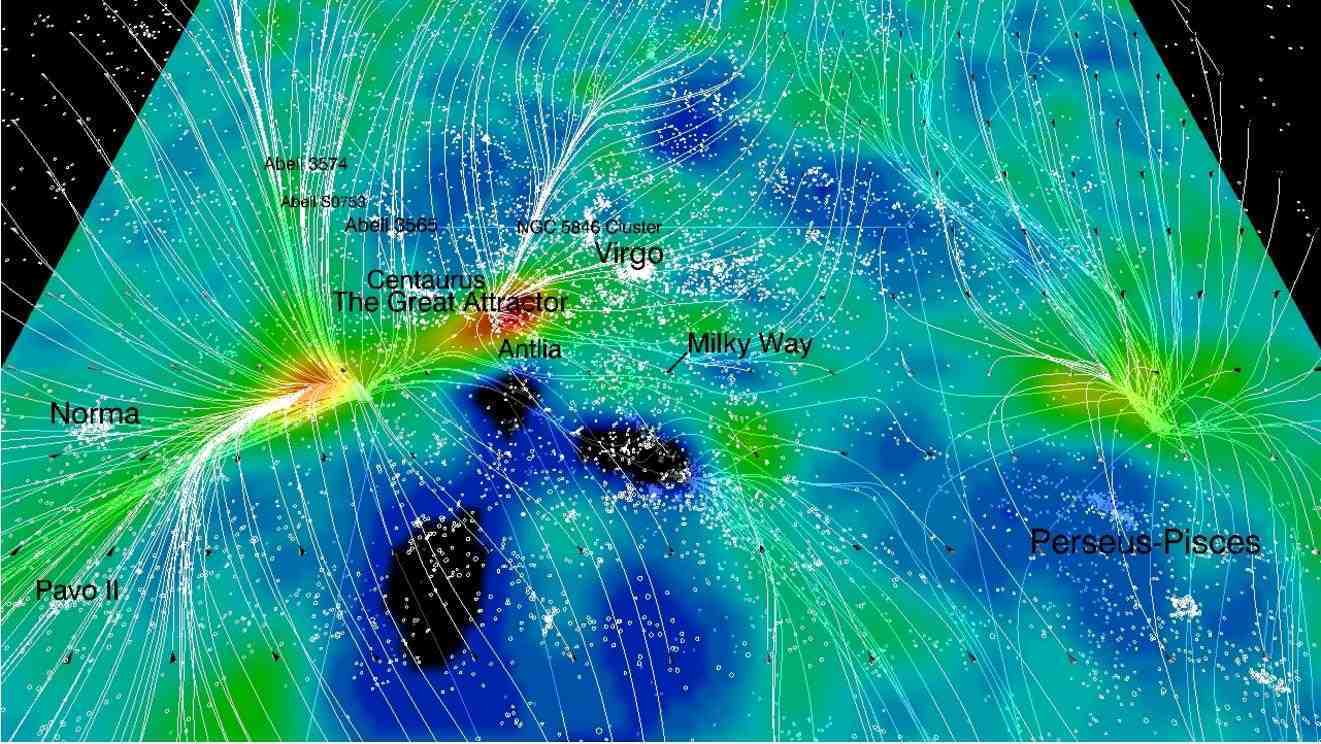 |
| Cosmic flow near the Local Group of galaxies. Credit: Courtois et al 2013; Cosmic Flows conference. |
You don't need to be an extragalactic astronomer to find the video below amazing.
This 17-minute video walks you through the distribution and velocities of galaxies within 300 million light-years of the Milky Way Galaxy. Distinct regions like the Virgo Cluster, the Local Void, and the Great Wall are easily seen and pointed out by the video. There's a lot of rotations going on, and the field of galaxies is complex, but the video does a good job of highlighting what's important at each step so that one is not completely overwhelmed. It's great to see where all these structures are and be reminded of how large the Universe is, as I tend to deal with stars that are a million times closer.
Check it out:
Thursday, May 30, 2013
Book Review: The Rithmatist by Brandon Sanderson

This is a story set in an alternate Earth where certain people, Rithmatists, can use geometry-based magic. By drawing lines of chalk, they are able to produce physical effects that help them in the never-ending battle against wild chalklings. These wild chalklings are controlled by no man, yet flow forth from a mysterious tower. In the midst of all this, students at a prodigious school start disappearing, seemingly kidnapped by a rouge Rithmatist. Joel, a young boy without Rithmatic abilities, but all the desire in the world to be one, quickly gets involved in the investigative work to figure out who is behind these kidnappings.
Read on for my full review.
Saturday, May 25, 2013
Book Review: Gone Girl by Gillian Flynn

Here's my review.
Subscribe to:
Posts (Atom)